

Saved Bookmarks
| 1. |
Consider a sphere of radius R withcharge density distributed as rho (R) = kr for r le R, rho (R) = 0for r gt R. (a) Find the electric field at all points r. (b) suppose the total charge on the sphereis 2e, where e is theelectron charge. Where can twoprotons be embedded such thatthe force on each of them is zero. Assume that the introduction of the proton does not alter the negativecharge distribution. |
Answer» Solution :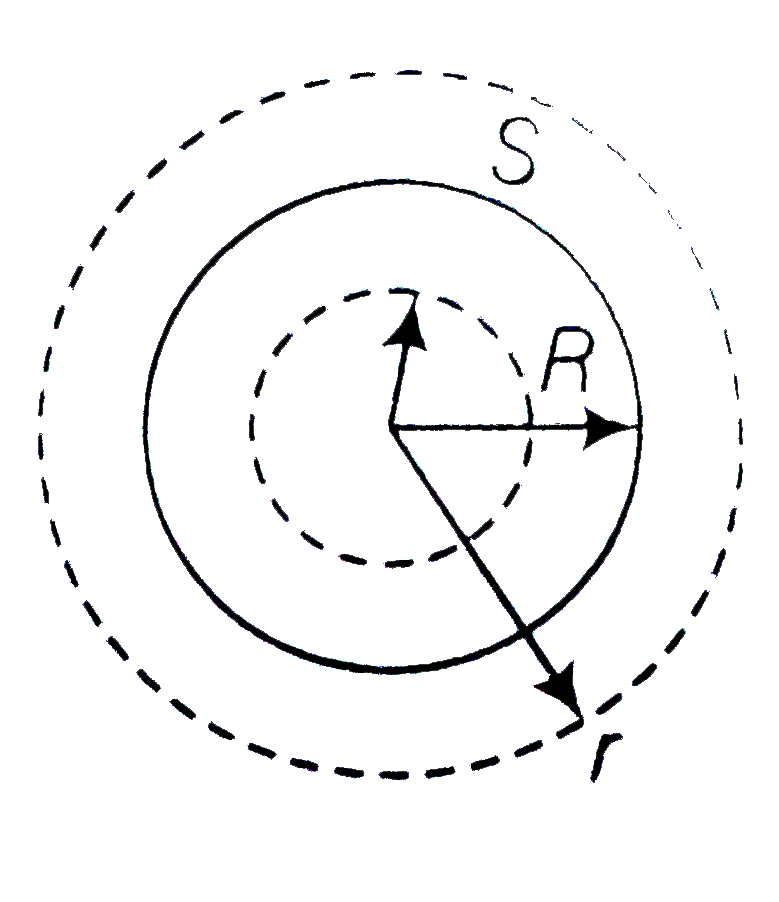 (a) Let us consider a SPHERE S of radius R and two hypothetic sphere of radius `r lt R and r gt R` Now, for point rltR, electric field intenstiy will be given by: `ointE.dS=(1)/(epsi_(0))intrhodV` [For dV, `V=(4)/(3)pir^(3)impliesdV=3xx(4)/(3)pir^(3)dr=4pir^(2)dr`] `impliesointE.dS=(1)/epsi_(0))4piKint_(0)^(r)r^(3)dr`(`becausep(r)=Kr`) `implies(E)4pir^(2)=(4piK)/(epsi_(0))(r^(4))/(4)` `impliesE=(1)/(epsi_(0))Kr^(2)` here, charge density of POSITIVE. So, direction of E is radially outwards. For points `r gtR`, electric field intenstiy will be given by `ointE.dS=(1)/(epsi_(0))intrho.dV` `impliesE(4pir^(2))=(4piK)/(epsi_(0))int_(0)^(R)r^(3)dr=(4piK)/(epsi_(0))(R^(4))/(4)` `impliesE=(K)/(4epsi_(0))(R^(4))/(r^(2))` Charge density is again positive. So, the directio of E is radially OUTWARD. (b). The two protons must be on the opposite sides of the centre along a diameter folloiwng the rule of symmetry. this can be shown by the figure given below. cahrge on the sphere. 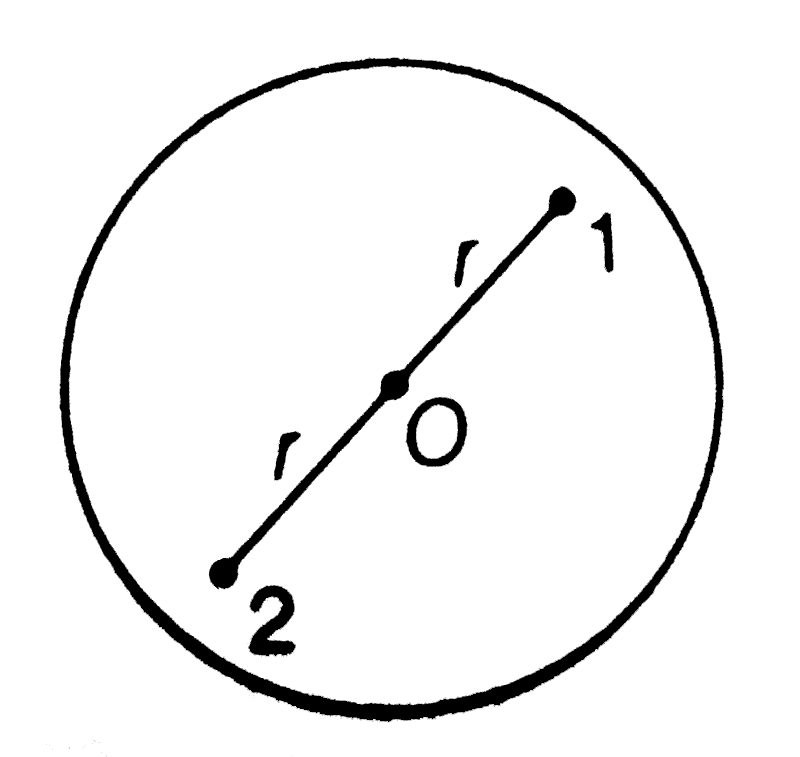 `q=int_(0)^(R)rhodV=int_(0)^(R)(Kr)4pir^(2)dr` `q=4piK(R^(4))/(4)=2e` `thereforeK=(2e)/(piR^(4))` If protons 1 and 2 are embedded at distance r from the centre of the sphere as shown, the attractive FORCE on proton 1 due to charge distribution is `F_(1)=EE=(-eKr^(2))/(4epsi_(0))` Repulsive force on proton 1 due to proton 2 is `F_(2)=(e^(2))/(4piepsi_(0)(2r)^(2))` ltBrgt Net force on proton 1, `F=F_(1)+F_(2)` `=F=(-eKr^(2))/(4epsi_(0))+(e^(2))/(16piepsi_(0)r^(2))` so, `F=[(-er^(2))/(4epsi_(0))(Ze)/(4piR^(4))+(e^(2))/(16piepsi_(0)r^(4))]` Thus, net force on proton 1 will be zero, when `(er^(2)2e)/(4epsi_(0)piR^(4))=(e^(2))/(16piepsi_(0)r)` `impliesr^(4)=(R^(4))/(8)` `impliesr=(R)/((8)^(1//4))` ltBrgt This is the distance of each of the two protons from the centre of the sphere. |
|