

Saved Bookmarks
| 1. |
Consider a system of two equal points charges, each Q = 8 muC, which are fixedat points (2m, 0 ) and (-2m, 0). Another charge mu is held at a point (0,0.1m) on the y-axis. Mass of the charge mu is 91 mg . At t= 0 , mu is released from rest and it is observed to oscillate along y-axis in a simple harmonic manner. It is also observed that at t = 0 , the force experienced by it is9 xx 10^(-3)N. Frequency of oscillation is |
|
Answer» 8 `F=(1)/(4piepsilon_(0))(Qq)/(Y^(2)+a^(2))` 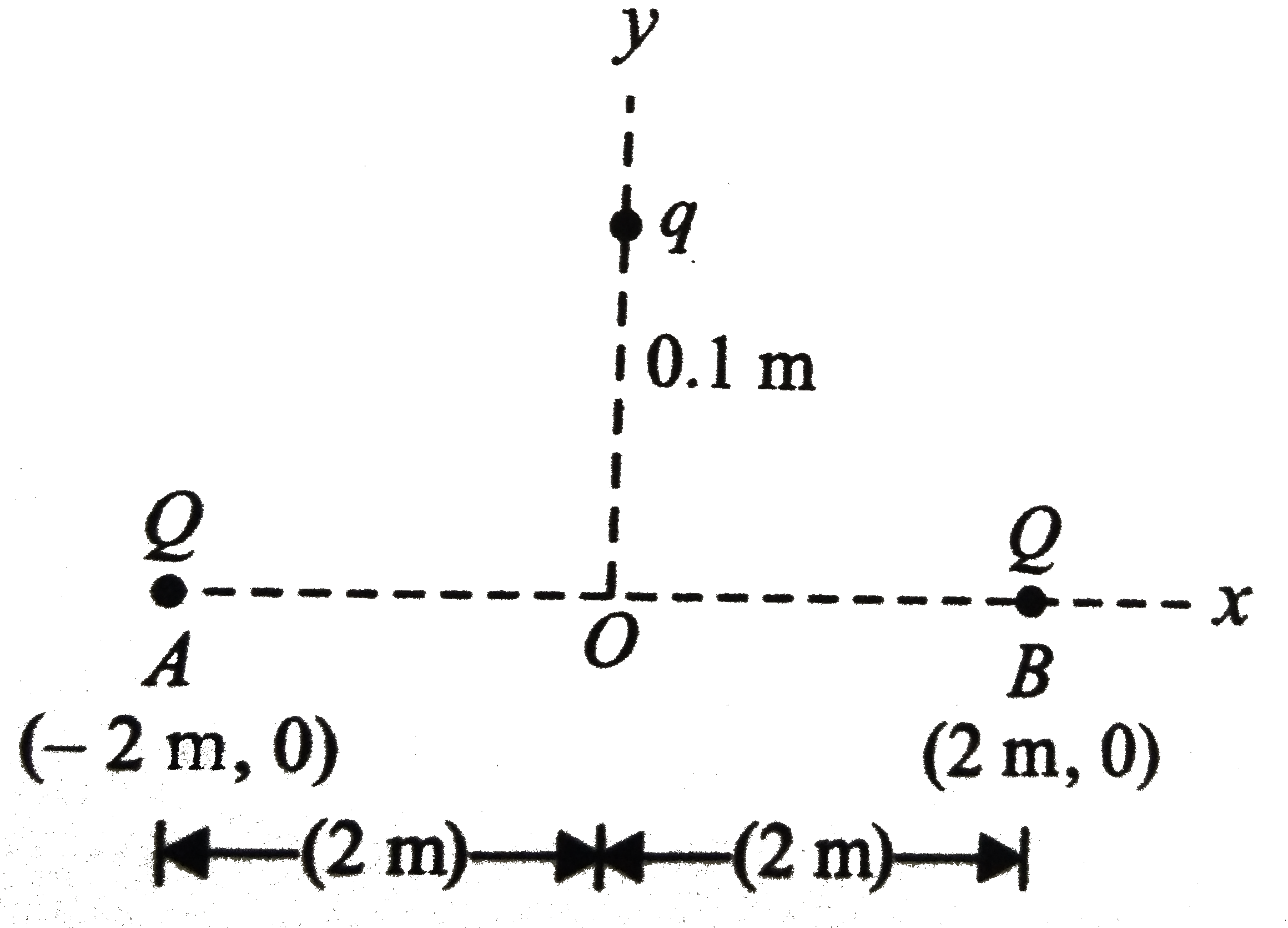 Force applied by `Q` at `A` on `q` can be resolved into rectangular components: `F omegas theta` and `F SIN theta`. Similarly, force applied by `Q` at `B` on `q` can be resolved into components: `F cos theta` and `F sin theta. F sin theta` components of the two forces balance each other so that the net force on `q` is `2F cos theta` toward `O`. Therefore, net force on q. `F_(n)=2(1)/(4piepsilon_(0))(Qq)/(y^(2)+a^(2))costheta` `F_(n)=(1)/(4piepsilon_(0))(2Qq)/(y^(2)+a^(2))(y)/((y^(2)+a^(2))^(1//2))=(1)/(4piepsilon_(0))(2Qqy)/((y^(2)+a^(2))^(3//2))`..(i) for `y lt lt a` net force on q, `F_(n)=(1)/(4piepsilon_(0))(2Qqy)/(a^(3))` ..(ii) Here `Q=8muC=8xx10^(-6)C` At `t=0`, q is at `y=0.1` m obviously `ylta(=2m)` since the motion is simple harmonic we can use the approximation `ylt le a` so initially i.e, at `y=0` m force on q is `9xx10^(-3)` N Units Eq. (i) we get or `9xx10^(-3)=(9xx10^(9))(2(8xx10^(-6))q(0.1))/((2)^(3))` or `q=5xx10^(-6)C=5muC` this, in fact, is the magnitude of q. We know that q, as explained earlier is a negative charge hence `q=-5muC` So correct option is (c). At `t=0` q is released at a piont 0.1 m from O on y-axis as it oscillates its other extreme position will be 0.1 m from O on the netative y-axis assuming undamped simple harmonic motion. Hence amplitude of oscillation is 0.1 m or 10 cm so correct option is (a). from fig we get `F_(n)=(1)/(4piepsilon_(0))(2Qqy)/(a^(3))=ky` ltbr where `k=(1)/(4piepsilon_(0))(2Qq)/(a^(3))` Thus, `F_(n)propy` we also know that `F_(n)` always acts towards O (mean position) time period of resulting SHM will be `T=2pisqrt(m//k)` of frequency is `(1)/(2pi)sqrt(k//m)` `f=(1)/(2pi)sqrt((1)/(4piepsilon_(0))(2Qq)/(ma^(3)))` `=(1)/((2xx3.14))sqrt((9xx10^(9))((2)(8xx10^(-6))(5xx10^(-6)))/((91xx10^(-6))(2)^(3)))=5` `[m=91mg=91xx10^(-6)kg]` thus the correct option is (c). In SHM, equation of displacement from mean position can be expressed as `y=asin(omegat+phi)` here `a=0.1mu,omega=2pif=2pixx5=10pi`, `y=0.1sin(10pit+phi)` but at `t=0,y=0.1` Hence `0.1=0.1sinphi` or `sinphi=1` or `phi=(pi)/(2),y=0.1sin(10pit+pi//2)` thus the correct option is (b). 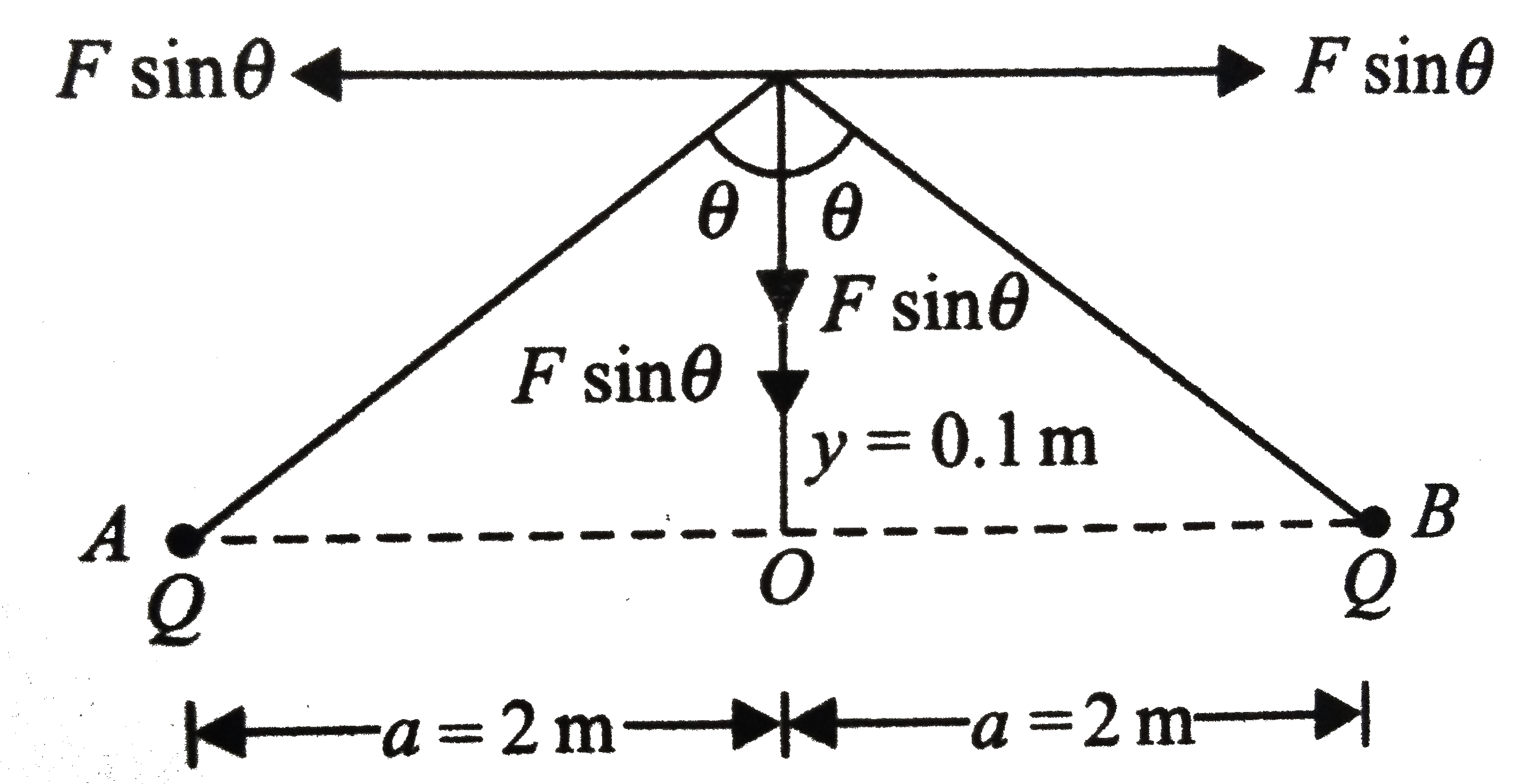
|
|