

Saved Bookmarks
| 1. |
Consider a two-particle system with particles having masses m_1and m_2 . If the first particle is pushed towards the centre of mass through a distance d, by what distance should the second particle be moved, so as to keep the centre of mass at the same position? |
|
Answer» `(m_2)/(m_1)d` `(m_1v_1 + m_2v_2)/(m_1 + m_2) = 0` Where, `v_1 andv_2` are the velocities of PARTICLES 1 and 2, respectively. `implies m_1(dr_1)/(dt) + m_2(dr_2)/(dt) = 0 ""[ :' v_1 = (dr_1)/(dt) and v_2 = (dr_2)/(dt)]` `implies m_1 dr_1 + m_1dr_2 = 0` `dr_1 and dr_2` represent the CHANGE in displacement of particles. Let `2^(nd) particle has been displaced by distancex. `implies` m_1(d) + m_2(x) = 0 "or" x = - (m_1d)/(m_2)` . 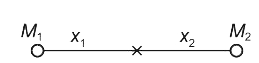 `X_(CM) = (m_1x_1 + m_2x_2)/(m_1 + m_2) "".....(i)` After MOVING `m_1`through a distancetowards CM and to keep the position of CM UNCHANGED, letbe the shift of`m_2`. `X_(CM) = (m_1(x_1 - d) + m_2(x_2 + d'))/(m_1 + m_2) "".....(iii)` From Eqs. (i) and (ii), we get `(m_1x_1 + m_2x_2)/(m_1 + m_2) = (m_1(x_1 -d)+m_2(x_2 + d))/(m_1 + m_2) implies -m_1d + m_2d' = 0 "":. ""d' = (m_1)/(m_2)d` . |
|