

Saved Bookmarks
| 1. |
Consider example 14, taking the coefficient of friction, mu to be 0.4 and calculate the maximum compression of the spring (g=10ms^(-2)) |
Answer» Solution :Both the frictional force and the spring force act so to oppose the compression of the spring as shown in figure. 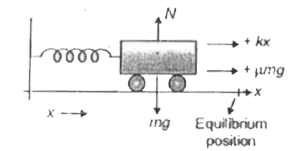 USE the work - energy theorem, The change in `KE=DeltaK=K_(f)-K_(i)=0-(1)/(2)mv^(2)` The work done by the net force is `W=-(1)/(2)Kx_(m)^(2)-mu mg x_(m)` Equating the two, we get `(1)/(2)mv^(2)=(1)/(2)Kx_(m)^(2)+mu mg x_(m)` `mumg=0.4xx1500xx10=6000N` `Kx_(m)^(2)+2mumg x_(m)-mv^(2)=0"(After rearranging the given equation)"` `x_(m)=(-2mu mg+sqrt(4mu^(2)m^(2)G^(2)-4(k)(-mv^(2))))/(2K)""("Taking +ve sign with square root as "x_(m)" is +ve")` `=(-mumg+sqrt(mu^(2)m^(2)g^(2)-4(k)(-mv^(2))))/(K)` `=(-0.4xx1500xx10+sqrt((0.4xx1500xx10)^(2)+1500xx7.5xx10^(3)xx10^(2)))/(7.5xx10^(3))` `=3.75m` Which, as expected, is less than the result in Example 14. If the two forces on the body consist of a conservative force `F_(c)` and a non - conservative force `F_(nc)` the conservation of mechanical energy FORMULA will have to be modified. By the W-E theorem. `(F_(c)+F_(nc))Deltax=DeltaK` But `F_(c)Deltax=-DeltaV` Hence, `Delta(K+V)=F_(nc)DeltaX` `DeltaE=F_(nc)Deltax` where E is the total mechanical energy. Over the path this assumes the form `E_(f)-E_(i)=W_(nc)` where `W_(nc)` is the total work done by the non - conservative forces over the path Unlike conservative force `W_(nc)` depends on the path taken. |
|