

Saved Bookmarks
| 1. |
Consider four equal charges q_(1),q_(2),q_(3) and q_(4)=q=+1muC located at four different points on a circle of radius 1m , as shown in the figure. Calculate the total force acting on the charge q_(1) due to all the other charges . |
|
Answer» Solution :According to the superposition principle the total electrostatic force on charge `q_(1)` is the vector sum of the forces due to the other charges, `vecF_(1)^("tot")= vecF_(12)+vecF_(13)+vecF_(14)` The following diagram shows the direction of each force on the charge `q_(1)` 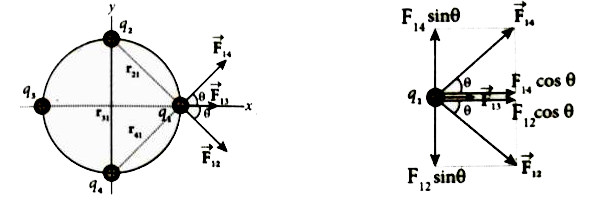 The charges `q_(2)` and `q_(4)` are equi-distant from `q_(1)` . As a result the strengths ( magnitude ) of the forces `vecF_(12)` and `vecF_(14)` are the same even though their directions are different . Therefore the vectors representing these two forece are drawn with equal length . But the charge `q_(3)` is located farther compared to `q_(2)` and `q_(4)` . Since the strength of the electrostatic force decreases as distance increases the strength of the force `vecF_(13)` is drawn with smaller length compared to that for forces `vecF_(12)` and `vecF_(14)` . From the figure `r_(21)= sqrt(2)m= r_(41) "and " r_(31)= 2m` The m agnitudes of the forces are given by `F_(13)=(kq^(2))/(r_(31)^(3))= (9xx10^(9)xx10^(-12))/(4)=2.25xx10^(-3)N` `F_(12)=(kq^(2))/(r_(21)^(2))=F_(14)=(9xx10^(9)xx10^(-12))/(2)=4.5xx10^(-3)N` From the figure the ANGLE `theta = 45^(@)` . In terms of the components we have `vecF_(12)=F_(12)cos thetahati-F_(12) SIN theta hatj= 4.5xx10^(-3)xx(1)/(sqrt(2))hati-4.5xx10^(-3)xx(1)/(sqrt(2))hatj` `vecF_(13)=F_(13)hati=2.25xx10^(-3)Nhati` `vecF_(14)=F_(14)costhetahati+F_(14) sin theta hatj=4.5xx10^(3)xx(1)/(sqrt(2))hati+4.5xx10^(-3)xx(1)/(sqrt(2))hatj` Then the total force on `q_(1)` is `vecF_(1)^("tot")=(F_(12)costheta hati-F_(12)sin thetahatj)+ F_(13)hati+(F_(14)cos thetahati+F_(14)sintheta hatj)` `vecF_(1)^("tot")=(F_(12) cos theta+F_(13)+F_(14)costheta) hati+(-F_(12)sintheta+F_(14)sin theta)hatj` Since `F_(12)=F_(14)` the `j^(th)` component is zero . Hence we have `vecF_(1)^("tot")=(F_(12)costheta+F_(13)+F_(14)costheta)hati` Substituting the values in teh above equation `=(4.5)/(sqrt(2))+2.25+(4.5)/(sqrt(2))hati=(4.5sqrt(2)+2.25)hati` `vecF_(1)^("tot")=8.61xx10^(-3)Nhati` The resultant force is ALONG the positive x axis . |
|