

Saved Bookmarks
| 1. |
Consider the charge configuration as shown in the figure . Calculate the electric field at point A. If an electron is placed at points A, what is the acceleration exerienced by this electron? (mass of the electron =9.1xx10^(-31) kg and charge of electron =-1.6xx10^(-19)C). |
|
Answer» Solution :By using superposition the net electric field at point A is `vecE_(A)=(1)/(4piepsilon_(0))(q_(1))/(r_(1A)^(2))hatr_(1A)+(1)/(4piepsilon_(0))(q_(2))/(r_(2A)^(2))hatr_(2A)` where `r_(1A)` and `r_(2A)` are the distances of point A from the two charges respectively. `vecE_(A)=(9xx10^(9)xx1xx10^(-6))/((2xx10^(-3))^(2))(hatj)+(9xx10^(9)xx1xx10^(-6))/((2xx10^(-3))^(2))(hati)` `=2.25xx10^(9)hatj+2.25xx10^(9)hati=2.25xx10^(9)(hati+hatj)` The magnitude of electric field `|vecE_(A)|=sqrt((2.25xx10^(9))^(2)+(2.25xx10^(9))^(2))=2.25xxsqrt(2)xx10^(9)NC^(-1)` The direction of `vecE_(A)` is given by `(vecE_(A))/(vecE_(A))=(2.25xx10^(9)(hati+hatj))/(2.25xxsqrt(2)xx10^(9))=((hati+hatj))/(sqrt(2))` which is the unit VECTOR along OA as shown in the figure . 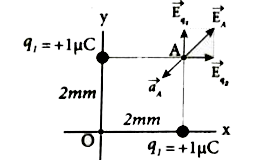 The acceleration experienced by an electronplaced at point A is `veca_(A)=(VECF)/(m)=(qvecE_(A))/(m) =(-1.6xx10^(-19)xx(2.25xx10^(9))(hati+hatj))/(9.1xx10^(-31))` `=-3.95xx10^(20)(hati+hatj)N` The electron is accelerated in a direction exactly OPPOSITE to `vecE_(A)` |
|