

Saved Bookmarks
| 1. |
Consider the following circuit with a switch S_(w). Potential difference of the cell is V. Initially, the switch is in position 1, connected to the left branch. After a long time the switch is shifted to position 2, to connect with the right branch. After the switch is shifted to position 2, find: (a) charge flowing through the switch. (b) work done by the battery. (c) heat loss in redistribution of charge. |
|
Answer» Solution :We can easily understand that in both the states of switch equivalent capacitance (C ) remains same, hence total stored CHARGE (Q = CV) also remains same. In both the states parallel combination of `C_(1)` and `C_(2)` is connected in series with another CAPACITOR `C_(1)` . We can write C and Q as follows: `C=(C_(1)(C_(1)+C_(2)))/(2C_(1)+C_(2))""...(i)` `Q=CV rArr Q=(C_(1)(C_(1)+C_(2))V)/(2C_(1)+C_(2)) "" ...(ii)` In the network `C_(1) and C_(2)` are connected in parallel and total charge Q is divided between them, proportional to their capacitance. Hence, charge stored in `C_(1) and C_(2)`, connected in parallel, is `Q_(1)=(QC_(1))/(C_(1)+C_(2)) and Q_(2)=(QC_(2))/(C_(1)+C_(2))`respectively. Distributionof charge in both the states of the circuit is shown in the figures. 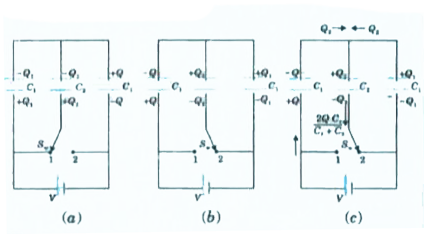 Fig-(a) shows charge distribution in state 1 of the circuit (when the switch is in position 1). Fig-(b) shows charge distribution in state 2 (when the switch is in positon 2) of the circuit. Fig-(c ) shows additional charge flowing through the various branches of circuit to adjust the charge distribution when the circuit changes its state. (a) LOWER plate of the middle capacitor has charge `(+QC_(2))/(C_(1)+C_(2))` in the first state and in the second state the same plate has to acquire final charge `(-QC_(2))/(C_(1)+C_(2))`. Hence, charge `(+2QC_(2))/(C_(1)+C_(2))` will be released by this plate, which will flow through the switch as shown in Fig-(c ). On substituting value of Q from equation (ii) we get charge flowing through the switch as follows: Charge through switch `=(+2(C_(1)(C_(1)+C_(2))V)/(2C_(1)+2C_(2))C_(2))/(C_(1)+C_(2))=(2C_(1)C_(2)V)/(2C_(1)+C_(2))` (b) Lower plate of the left capacitor`(C_(1))` has a charge `(+QC_(1))/(C_(1)+C_(2))` in the first state and the same plate has to acquire +Q charge in the second state of the circuit. Hence, charge `(+QC_(2))/(C_(1)+C_(2))` MUST flow from positive terminal of the batery towards the lower plate of left capacitor. Hence, additional charge `(+QC_(2))/(C_(1)+C_(2))` is supplied by the positive terminal battery when switch is shifted from position-1 to the positon-2. Work done by the battery = (Charge supplied by the battery) `xx` (potential difference of battery) `W_(b)=(QC_(2))/(C_(1)+C_(2))V=((C_(1)(C_(1)+C_(2))V)/(2C_(1)+2C_(2))C_(2))/(C_(1)+C_(2))V=(C_(1)C_(2)V^(2))/(2C_(1)+C_(2))` (c ) We already know that equivalent capacitance in both the states of the circuit is same and that potential difference applied is also the same. Hence, energy stored in the circuit has to be the same in both states. `U_(1)=U_(2)` According to energy conservation: `U_(1)+W_(b)=U_(2)+H` `rArr H=W_(b)=(C_(1)C_(2)V^(2))/(2C_(1)+C_(2))` |
|