

Saved Bookmarks
| 1. |
Consider the L-C-R circuit shown in the fiure. Find the net current I and the phase of i. Show that i=V/Z. Find the impedance Z of this circuit. |
|
Answer» So, we can write `i=i_(1)+i_(2)` `V_(m)SINOMEGAT=Ri_(1)`(from the circuit diagram) `i_(1)=(V_(m)sinomegat)/(R)`.............(i) If `q_(2)` is charge on the CAPACITOR at any time t, then for series combination of C and L. APPLYING KVL inthe Lower circuit as shown. 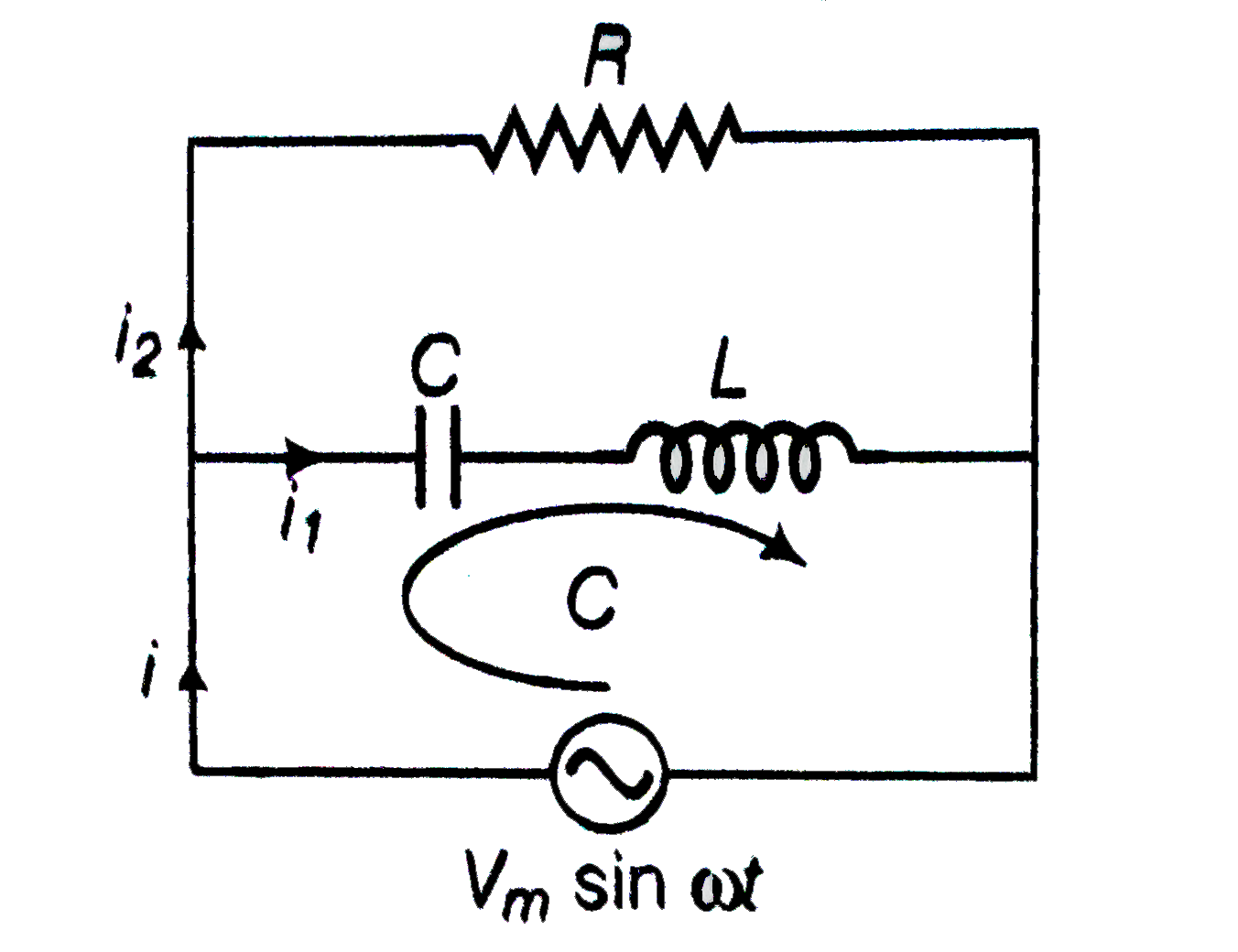 `q_(2)/C + (Ldi_(2))/(dt) - V_(m)sinomegat=0` `rArr q_(2)/C + (Ld_(2)q_(2))/(dt)^(2) = V_(m)sinomegat``[therefore i_(2)=(dq_(2))/(dt)]`......(ii) Let `q_(2) = q_(m) sin (omegat+phi)`..............(iii) `(dq_(2))/(dt) = q_(m)cos(omegat+phi)` `rArr (d^(2)q_(2))/(dt^(2))=-q_(m)omega^(2)sin(omegat+phi)` Now putting the values in Eq. (ii), we GET `q_(m)[1/C+l(-omega^(2))]sin(omegat+phi)=V_(m)sinomegat` If `phi = 0` and `(1/C-Lomega6(2)) gt 0,` then `q_(m)=v_(m)/(1/C-Lomega^(2))`..............(iv) From Eq. (iii), `i_(2) = (dq_(2))/(dt) = omegaq_(m)cos(omegat+phi)` Using Eq. (iv), `i_(2) = (omegaV_(m)cos(omegat+phi))/(1/C-Lomega^(2))` Taking `phi =0, i_(2)=(V_(m)cos(omegat))/(1/(omegaC)-Lomega)` From Eqs. (i) and (v), we find that `i_(1)` and `i_(2)` are out of phase by `phi/2` Now, `i_(1)+ i_(2) = (V_(m)sinomegat)/R + (V_(m)cosomegat)/(1/(omegaC)-Lomega)` Put `V_(m)/R = A = C cosphi` and `V_(m)/(1/(omegaC)-Lomega)=B = C sinphi` `therefore i_(1) + i_(2) = C cos phisinomegat+ C sinphi cos omegat` `= C =sqrt(A^(2) + B^(2)` and `phi=tan^(-1)B/AC = [V_(m)^(2)/R^(2) + (V_(m)^(2))/(1/(omegaC)-Lomega)]^(1//2)` and `phi = tan^(-1) =R/(1/(omegaC)-Lomega)` Hence, `i=i_(1)+i_(2)= [V_(m)^(2)/R^(2) + V_(m)^(2)/(1/(omegaC)-Lomega)^(2)]^(1//2)sin(omegat+phi)` or `i/V_(m)=1/Z =[1/R^(2)+1/(1/(omegaC)-Lomega)^(2)]^(1//2)` This is the expression for impedance Z of the circuit. |
|