

Saved Bookmarks
| 1. |
Consider the situation shown in figure. Both the pulleys and the strings are light and all the surfaces are frictionless. Calculate (a) the acceleration of mass M, (b) tension in the string PQ and (c ) force exerted by the pulley P. |
|
Answer» Solution :As pully Q is not fixed so if it moves a distance d athe length of string between P and Q will changes by 2nd ( d from above and d from below), i.e., M will move 2d. This in turn implies that if a is the acceleration of M the acceleration of Q and of 2M will be `a/2.` now if we CONSIDER the motion of mass M, it is accelerated DOWNWARD, so T=M(g-a)........(i) And for the motion of Q `2T-T'0xxa/2=0impliesT'=2T"".......(ii)` And for the motion of mass `2MT'=2M((a)/(2)),impliesT'=Ma""(III)` 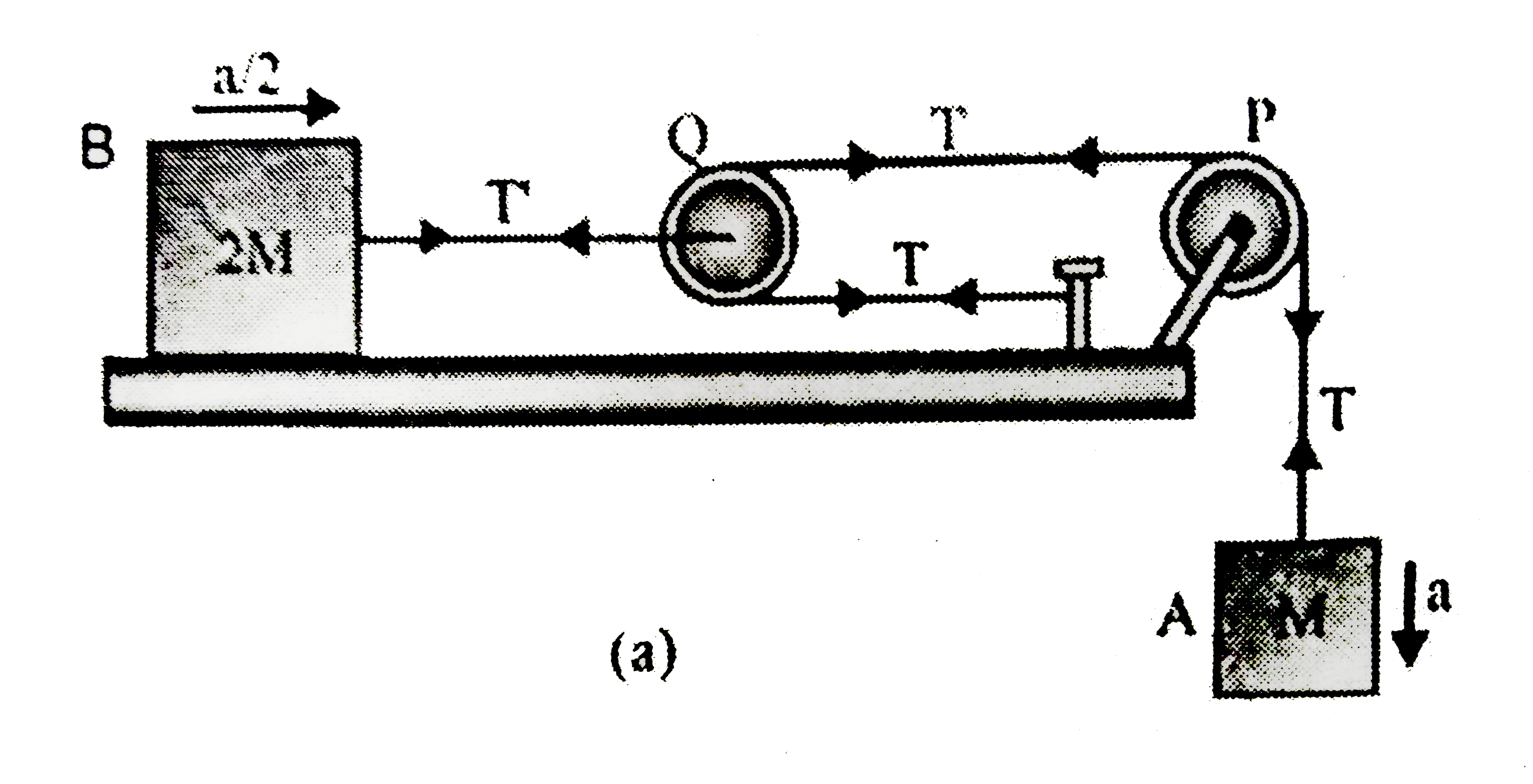 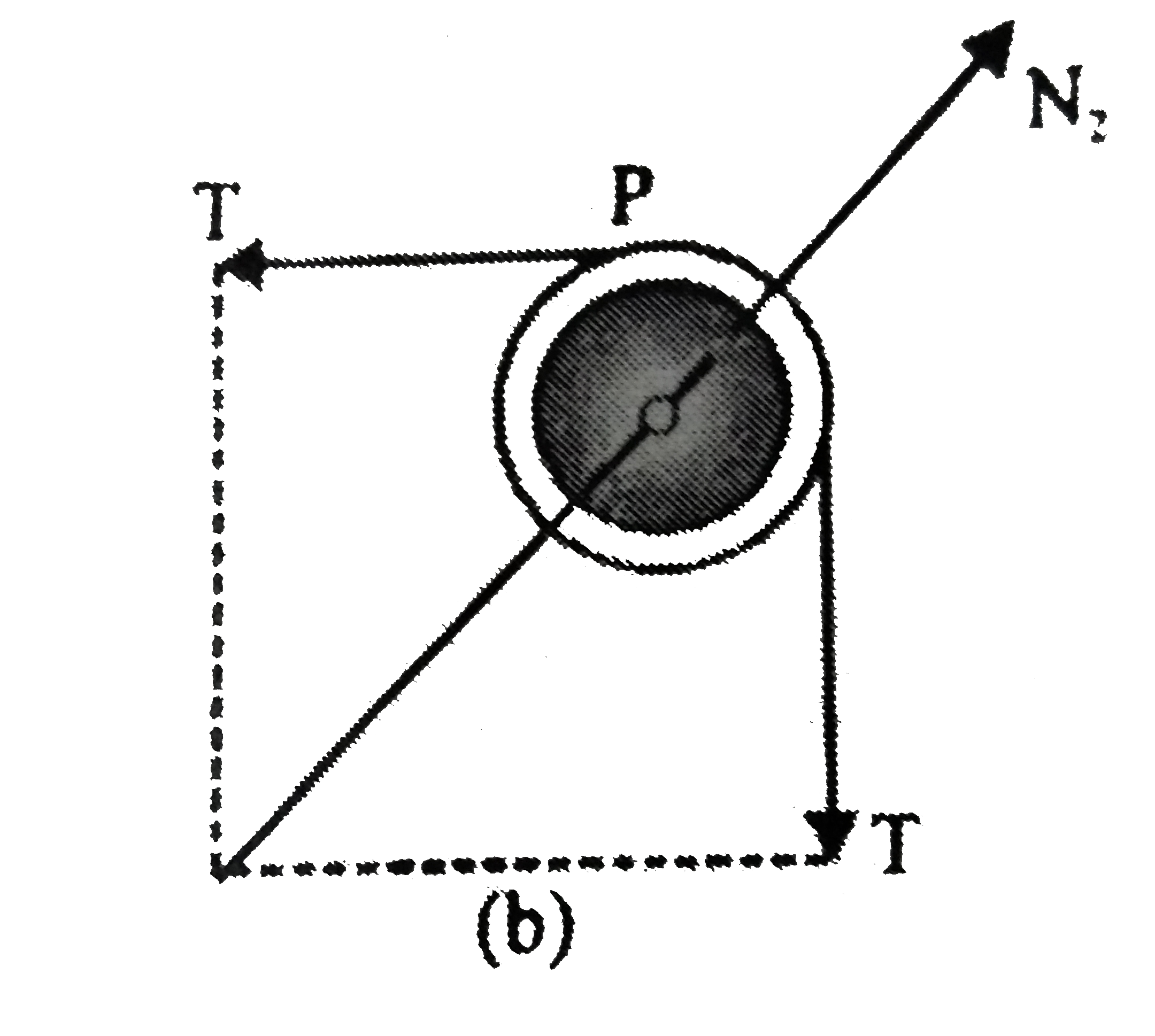 (a) From equation (ii) and (iii) as `T=1/2Ma,` so equation (i) reduces to `T=1/2Ma(g-a)impliesa=2/3g` while tension in the string PQ from equation (1) will be `T=M"("g-2/3g")"=1/3Mg` (C ) Now from figure (b), it is clear that force on pulley by the CLAMP will be equal and opposite to the resultant of T and T at `90^(@)` to each other, i.e., `(N_(2))=sqrt(T^(2)+T^(2))=sqrt(2)T=(sqrt2)/(3)Mg` |
|