

Saved Bookmarks
| 1. |
Consider two parallel co-axial circular coils of equal radius R, and number of turns N, carrying equal currents in the same direction, and separated by a distance R. Show that the field on the axis around the mid-point between the coils is uniform over a distance that is small as compared to R, and is given by B=0.72 (mu_(0)NI)/(R) approximately. [Such an arrnagement to produce a nearly uniform magnetic field over a small region is known as Helmholtz coils. ] |
|
Answer» Solution :Radius of two parallel co-axial coils = R, number of turns =N Current =I Let the mid pints between the coils is at point O and P be the point around the mid point O. Suppose, the distance between OP=d which is very less than `R(d LT lt R)` For the coil A, `O_(A)P=(R)/(2)+d` the magnetic field at point P DUE to coil A. `B_(A)=(mu_(0))/(4pi).(2pi nI R^(2))/((O_(A)P^(2)+R^(2))^(3//2))` `=(mu_(0))/(2). (NIR^(2))/({(Rl_(2)+d)^(2)+R^(2)}^(3//2))=(mu_(0)NIR^(2))/(2[(R^(2))/(4)+d^(2)+Rd+R^(2)]^(3//2))` as according to the question `d lt lt R`, so neglect turn `d^(2)`. `B_(A)=(mu_(0)NIR^(2))/(2[(5R^(2)=)/(4)+Rd]^(3//2))=(mu_(0)NIR^(2))/(2xx((5R^(2))/(4))^(3//2)[1+(Rxxdxx4)/(5R^(2))]^(3//2))` `=(mu_(0) NIR^(2)(1+(4d)/(5R))^(-3//2))/(2((5R^(2))/(4))^(3//2))rarr(1)` The direction of `B_(A)` is along `PO_(B)`. According to Maxwell's right hand rule for the coil `B,O_(B)P=(Rl_(2)-d)` The magnetic field at point P due to coil B `B_(B)=(mu_(0))/(4pi).(2pi NIR^(2))/((O_(B)P^(2)+R^(2))^(3//2))=(mu_(0))/(2).(2NIR^(2))/(([(R)/(2)-d]^(2)+R^(2))^(3//2))` `=(mu_(0)NIR^(2))/(2[(R^(2))/(d)+d^(2)-Rd+R^(2)]^(3//2))=(mu_(0)NIR^(2)(1-(4d)/(5R))^(-3//2))/(2((5R^(2))/(4))^(3//2))` The direction of magnetic field `B_(B)` is TOWARDS `PO_(B)`. S0, the resultant magnetic field at P due to coil A and coil B is `B=B_(A)+B_(B)=(mu_(0)NIR^(2))/(2((5R^(2))/(4))^(3//2)).[(1+(4d)/(5R))^(-3//2)+(1-(4d)/(5R))^(-3//2)]` Now, use binomial theorem and neglect higher power as `d lt lt R` `B=(mu_(0)NIR^(2))/(2((5R^(2))/(4))^(3//2))[1-(3)/(2)xx(4d)/(5R)+1+(3)/(2)xx(4d)/(5R)]` `=(mu_(0)NI)/(2R)((4)/(5))^(3//2)xx2` `=((4)/(5))^(3//2).(mu_(0)NI2)/(2R)=(2mu_(0)NI)/((5)^(3//2).2R)(4)^(3//2)` `=0.72. (mu_(0)NI)/(R)` 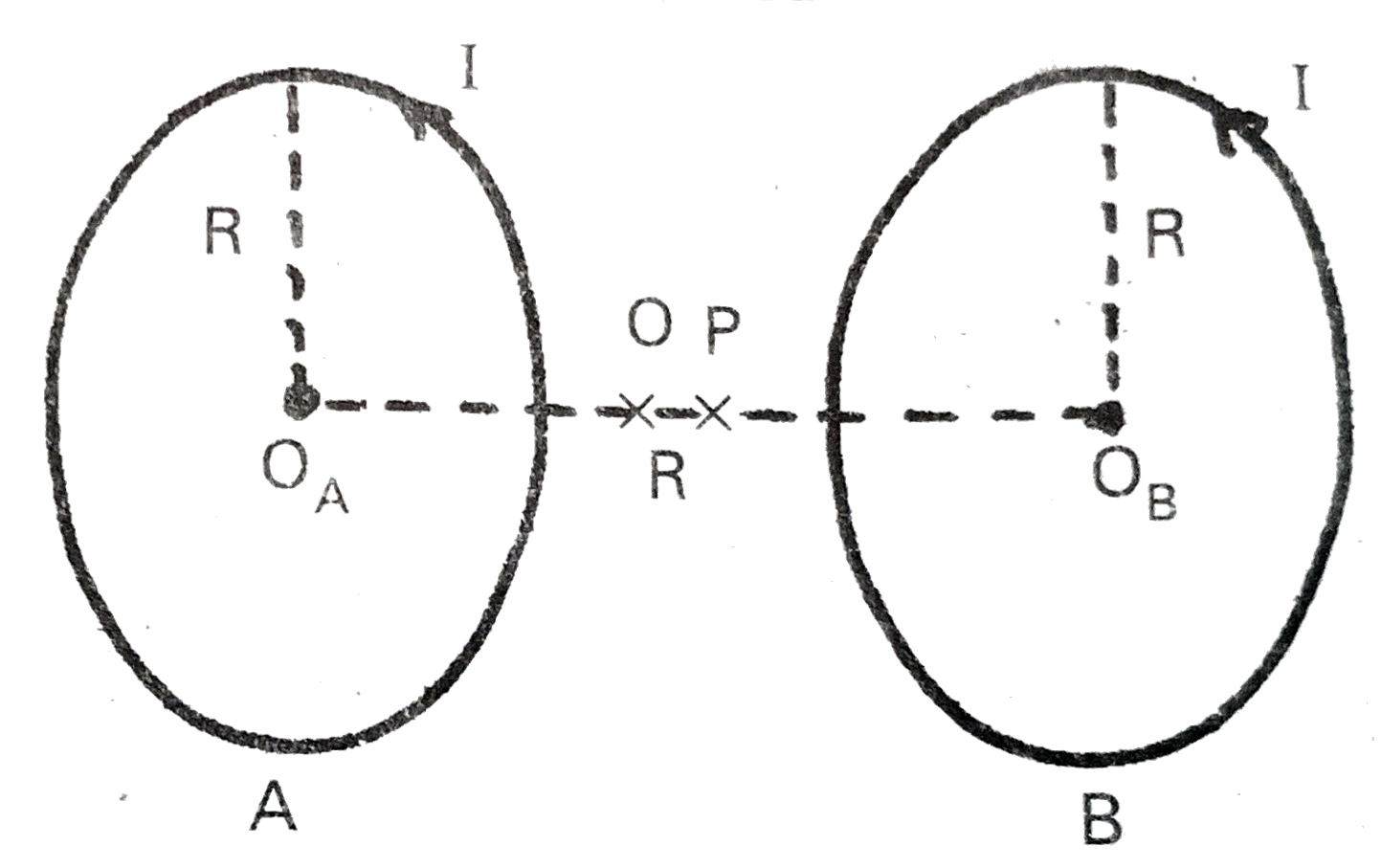
|
|