

Saved Bookmarks
| 1. |
Considering the parameters such as bond dissociation enthalphy, electron gain enthalpy and hydration entalpy, compare the oxidising power of F_2 and Cl_2. |
Answer» Solution :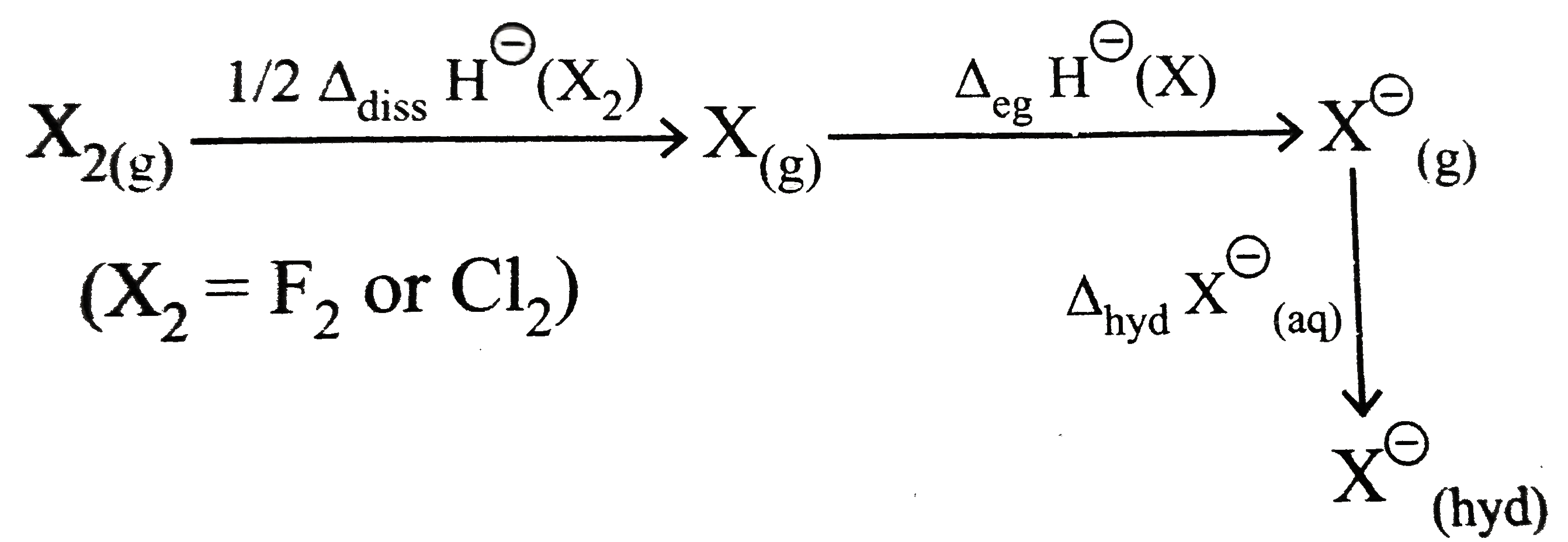 Elctrode potenential depends on: `E=(1)/(2)Delta_(diss)H^(ɵ)(X_(2))+Delta_(eg)H^(ɵ)(X)+Delta_(hyd)H^(ɵ)(X^(ɵ))` Although, electron GAIN enthalpy of fluorine is less negative than that of chlorine the bond dissociation enthalpy of `F-F` bond is MUCH lower than `Cl-Cl` bond and hydration enthalpy of `F^(ɵ)` ion is much HIGHER than that of `Cl^(ɵ)` ion. The later two factors more than compensate the less negative electron gain enthalpy of `F_2`. Consequently electrode potential of `F_2` is higher than `Cl_2` and `F_2` is a much stronger oxidising agent than `Cl_2`. |
|