

Saved Bookmarks
| 1. |
Deduce coulomb's law in electrostatics from Gauss theorem. Or State and prove Gauss's law in electrostatics. |
|
Answer» Solution :Gauss.s Theorem. It states that the total electric flux through any closed surface is equal to `(1)/(epsi_(0))` TIMES the total electric CHARGE enclosed by the surface. Mathematically, `phi=ointvec(E).dvec(S)=(q)/(epsi_(0))` Proof. Consider a closed spherical surface S and a point charge +q be placed at its centre O as shown in the figure. consider a small element of area dS around point P through which the electric flux `dphi` is given by `dphi=vec(E),dvecS` 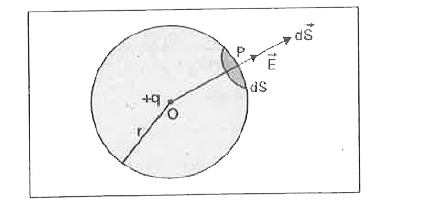 Total electric flux linked whole closed surface S will be `phi=ointdphi=ointvecE.dvecS` or `phi=ointEdScos0^(@)=ointEdS`. .(i) The electric FIELD intensity E at P due to charge q at O is given by `E=(1)/(4piepsi_(0))(q)/(r^(2))`. . (ii) Putting Eq. (ii) in Eq. (i), we GET `phi=oint(1)/(4piepsi_(0))(q)/(r^(2))dS` `=(1)/(4piepsi_(0)r^(2))ointdS` `=(1)/(4piepsi_(0)r^(2))4pir^(2)` or `phi=(q)/(epsi_(0))` This is Gauss theorem. Coulomb.s law from Gauss Theorem Consider an isolated positive charge +q at O. imagine a sphere of radius r and centre O. Electric field `vecE` at every point on the sphere is the same and is DIRECTED outwards. direction of small area element `vec(dS)` is also along `vecE` i.e., the angle between `vec(E)` and `vec(dS)` is `0^(@)`, According to Gauss theorem, `oint_(S)vecE.vec(dS)=(q)/(epsi_(0))` 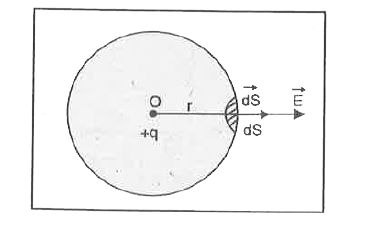 or `oint_(S)EdScos0^(@)=(q)/(epsi_(0))` or `Eoint_(S)dS=(q)/(epsi_(0))` or `Exx4pir^(2)=(q)/(epsi_(0))` or, `E=(q)/(4piepsi_(0)r^(2))` If another charge `q_(0)` is placed on the sphere then force F on it is `F=q_(0)E=(q_(0)q)/(4piepsi_(0)r^(2))` which is coulomb.s law. |
|