

Saved Bookmarks
| 1. |
Deduce the expression, N=N_(0e)^(-lambdat), for the law of radioactive decay. |
|
Answer» Solution :Radioactive decay LAW: The RATE of decay of radioactive nuclei is directly proportional to the number of undecayed nuclei at that time. Derivation of Formula Suppose initially the number of atoms in radioactive element is No and N the number of atoms after time t. After time t, let dN be the number of atoms which disintegrate in a short intervaldt, then rate of disintegration will be `(dN)/(dt)`, this is also called the activity of the substance/element. According to Rutherford-Soddy law `(dN)/(dt), alphaN` or `(dN)/(dt), =- lambdaN` ..(i) where `lambda`is a constant, called decay constant or disintegration constant of the element. Its unit is `s^(–1)`. Negative sign shows that the rate of disintegration decreases with increase of time. For a given element/substance `lambda` is a constant and is different for different elements. Equation (i) may be rewritten as `(dN)/N=(-lambdadt)` Integrating `log_e, N=-lambdat+C`...(ii ) where C is a constant of INTEGRATION. At `t=0, N=N_0` `therefore log_e N_0=0+C * * C = log_e N_0` `therefore` Equation (ii) gives `log_eN=-lambdat+log_e N_0` or `log_eN-log_eN_0=-lambdat` 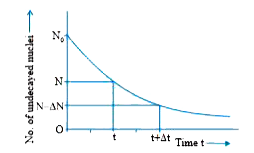 According to this equation, the number of undecayed atoms/nuclei of a given radioactive element decreases EXPONENTIALLY with time (i.e., more rapidly at first and slowly afterwards). Mark of `N=N_0/16` in terms of `T_(1//2)` is shown in fig. |
|