

Saved Bookmarks
| 1. |
Define linear S.H.M. Show that S.H.M.Is a projection of U.C.M. on any diameter. A metal spherecools at the rate of 4^(@)C/min. when its temperatureis 50^(@)C.Findits rate ofcooling at 45^(@)Cif the temperatureof surroundings is 25^(@)C. |
|
Answer» Solution :Linear S.H.M.Is the simplestkind of OSCILLATORYMOTION in WHICHA bodywhen displcedfrom its MEAN position,oscillates 'toand fro'about meanposition and the restoringforce (or acceleration)is alwaysdirectedtowardsits mean positionand its magnitudeis directlytowardsits mean positionand its magnitudeis directly proportionalto the displacementform the meanposition. Consider a particleP movingalongthe circumferenceof a circleof radiusa with uniformangularspeed of `omega` inanticlockwise direction asshown. Particles P alongcircumferenceof the circlehas itsprojectionparticleon diameter ABat point M. 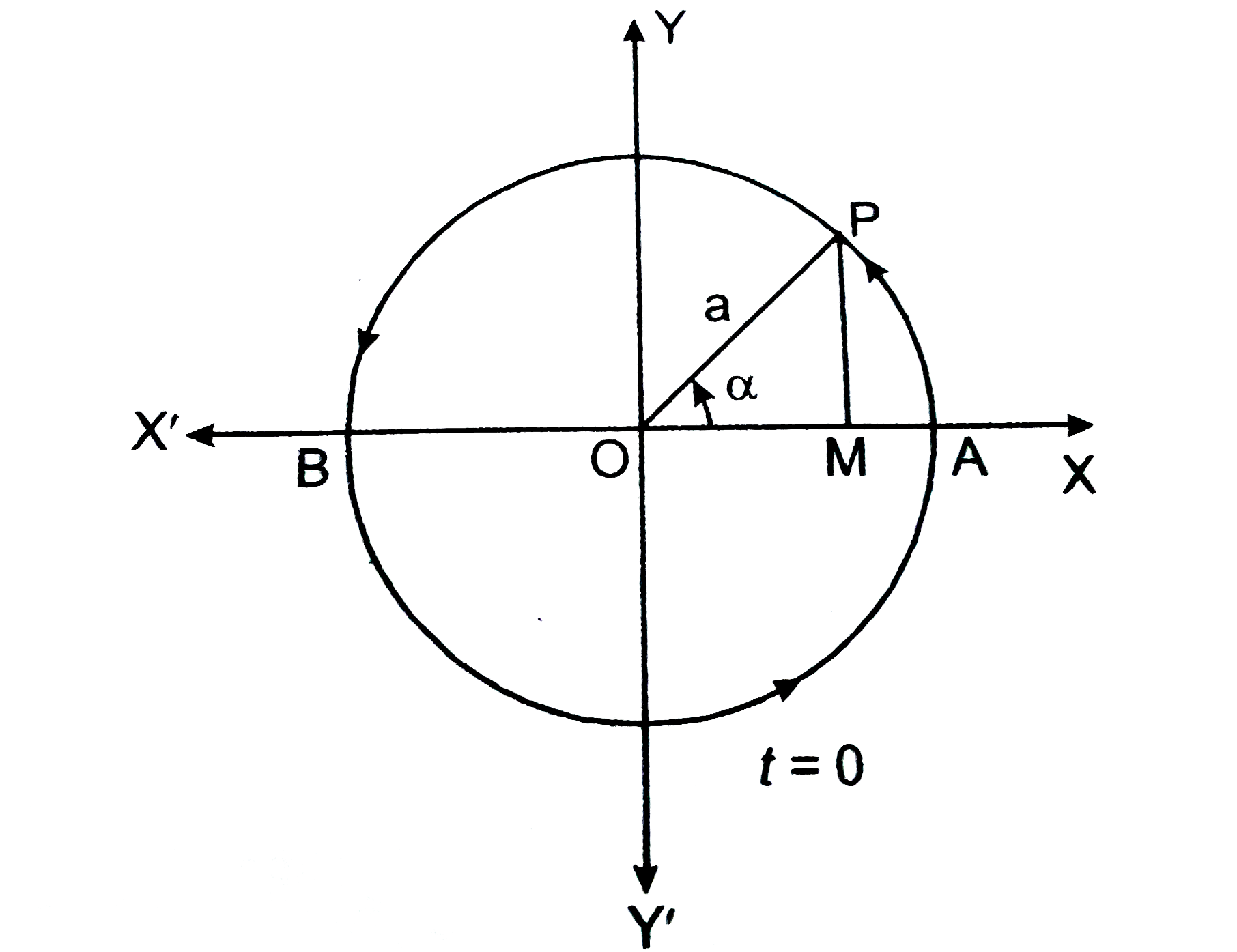 Supposethat particleP startsfrom the initialpositionwith initial phase angle `alpha` (angle betweenradiusOP and the X- axis at the time `t = 0` ) In time t, the anglebetween OP and X-axis is `(omegat + alpha)`particle P movingwith constantangularvelocity `(omega)`as shown. 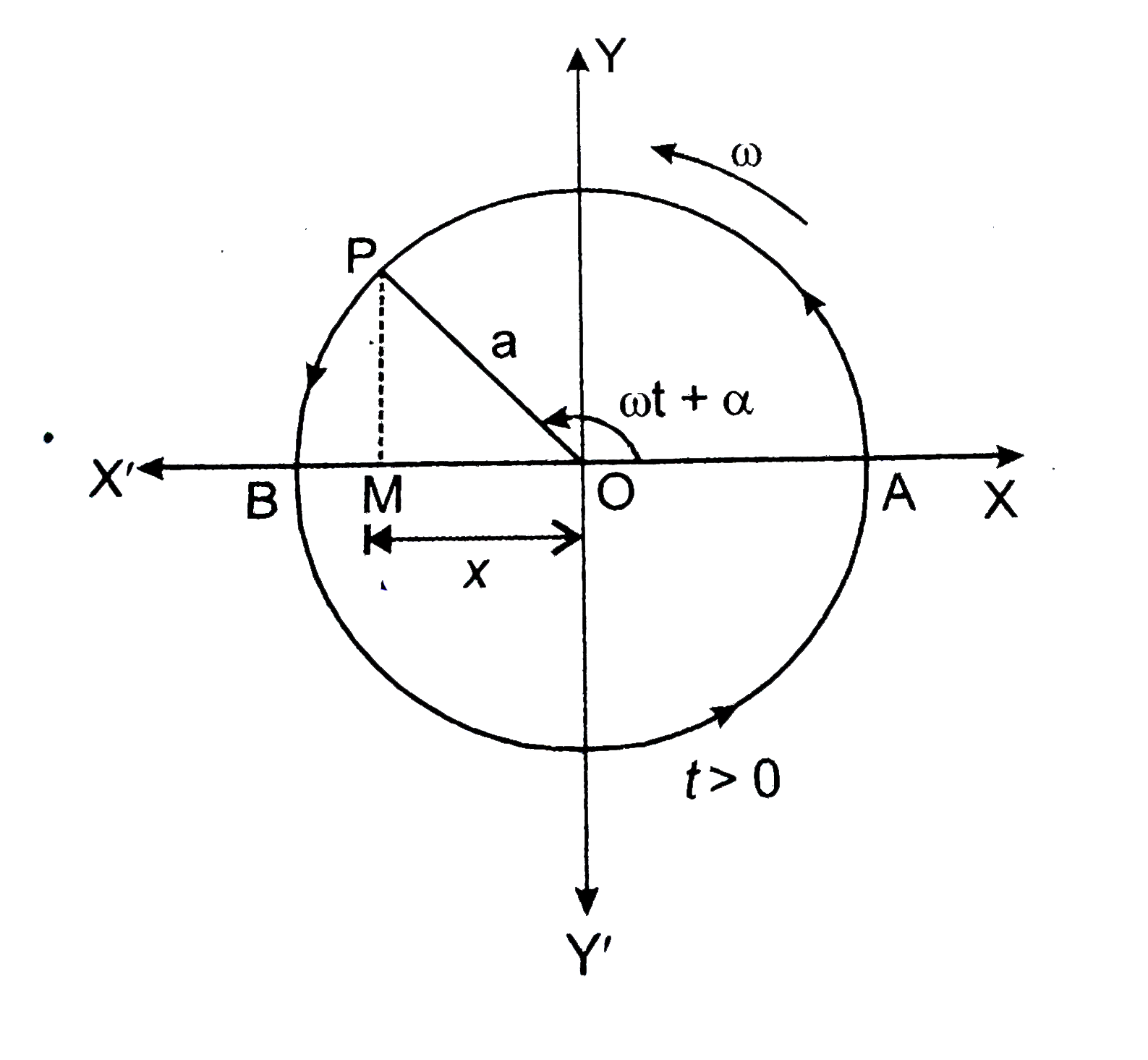 `cos (omegat + alpha) - x/a` `:.x= a cos (omega t + alpha) "..."(i)` This is the expansionfor displacementof particleM at time t. As VELOCITYOF the particleis the time rate of change of displacement then we have `v= (dx)/(dt) = (d)/(dt)` `[a cos (omegat + alpha)]` `:. v = - a omegasin (omegat + alpha) "..."(ii)` As accelerationof particle is the time rate of change of velocity,we have `a = (dv)/(dt) = d/(dt) [-aomega sin (omegat + alpha)]` `:. a = - aomega^(2) cos (omegat + alpha)` `:. a = - omega^(2)x` Hence, the projectionof a uniformcircular motion on a diameterof a circle is simple harmonicmotion. Numerical : Given thatfor the metalsphere, `((dtheta)/(dt))_(1) = 4^(@)C//"min"`. `theta_(1) = 50^(@)C, theta_(2) = 45^(@)C` and `theta_(0) = 25^(@)C` . By Newton's law of cooling, `((d theta)/(dt))= k(theta - theta_(0))` `:. ((d theta//dt)_(1))/((d theta//dt)_(2)) = ((theta_(1)- theta_(0)))/(theta_(2) - theta_(1)))` `:. ((d theta//dt)_(1))/((d theta//dt)_(2)) = ((50^(@) - 25^(@)))/((45^(@) - 25^(@)))` `:. ((d theta)/(dt))_(2) = (20^(@))/(25^(@)) xx ((d theta)/(dt))_(1) = (20^(@))/(25^(@)) xx 4 = 3.2` `:. ((d theta)/(dt))_(2) = 3.2^(@)C//"min"` |
|