

Saved Bookmarks
| 1. |
Define resistivity of a conductor. Plot a graph showing the variation of resistivity with temperature for a metallic conductor. How does one explain such a behaviour, using the mathematical expression of the resistivity of a material |
|
Answer» Solution :We know that,`R=p 1/A`, IF Thus, resistivity of a material is numerically equal to the resistance of the conductor having unit length and unit cross-sectional area The resistivity of a material is found to be dependent on the temperature. Different materials do not EXHIBIT the same DEPENDENCE on temperatures. Over a limited RANGE of temperatures, that is not too large, the resistivity of a metallic conductor is approximately given by, .`P_T=p_0[1+a(T-T_0)]` ...........(i) Where `p_T`is the resistivity at a temperature T and`p_0` is the same at a reference temperature`T_0`is CALLED the temperature co-efficient of resistivity. The relation of equation (i) implies that a graph of`p_T`plotted against T would be a straight line. At temperatures much lower than `0^@C`, the graph, however, deviates considerably from a straight line (fig.)Resistivity `p_T`of metallic conductor as a FUNCTION of temperature T. 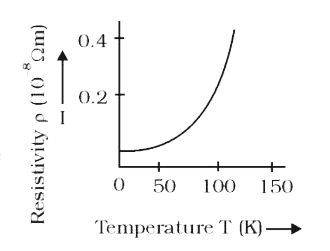
|
|