

Saved Bookmarks
| 1. |
Derive a relation for electric field of an electric dipole at a point on its equitorial line. |
|
Answer» <P> Solution :Consider an ELECTRIC dipole having two charges -q and +q lying at A and B at a distance 2l. Let us determine electric field intensity at point P on the equitorial line at a distance r from the centre O of the dipole. Electric field intensity `E_(+)` DUE to charge +q and `E_(-)` due to charge -q at P are given by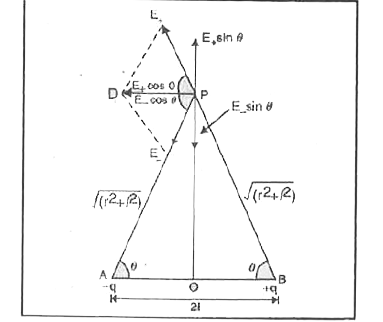 `E_(+)=K(q)/((r^(2)+l^(2)))""[K=(1)/(4piepsi_(0))]` `E_(-)=K(a)/((r^(2)+l^(2)))` Resolving `E_(+) and E_(-)` into rectangular components, we have `E_(+)COSTHETA+E_(-)costheta` along PD. `E_(+) sintheta and E_(-) sin theta` being equal and opposite mutually cancel each other. `therefore`Net electric field at P is given by `E_(eq)=E_(+)costheta+E_(-)costheta` `=2Ecostheta""[becauseE_(+)=E_(-)=E(say)]` `=2(Kq)/(r^(2)+l^(2))*(l)/((r^(2)+l^(2))^(1//2))` `[becauseIn" rt "ltd DeltaAOP,costheta=(l)/(AP)=(1)/((r^(2)+l^(2))^(1//2))]` `=K((q2l))/((r^(2)+l^(2))^(3//2))` or `E_(eq)=K(p)/((r^(2)+l^(2))^(3//2))` `=(1)/(4piepsi_(0))(p)/((r^(2)+l^(2))^(3//2))""[becausep=q2l]` |
|