

Saved Bookmarks
| 1. |
Derive an expression for a thin double convex lens. Can you apply the same to a double concave lens too? |
|
Answer» <P> Solution :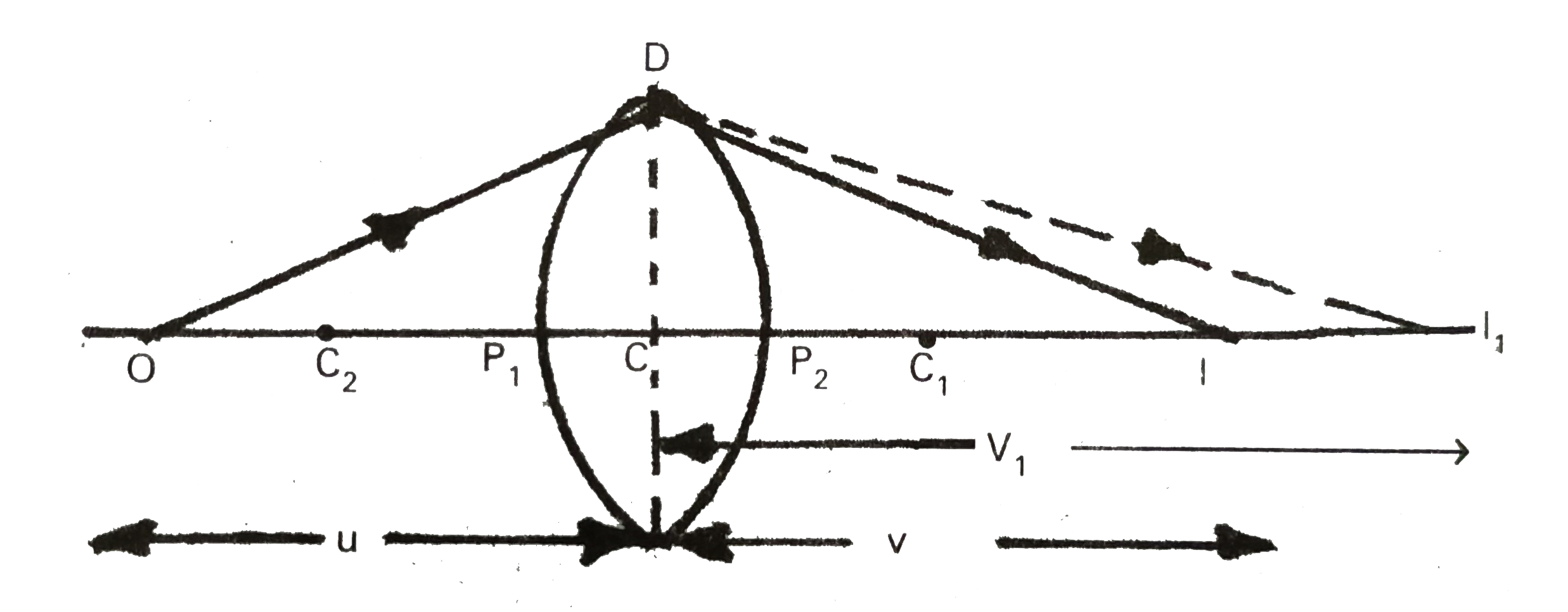 i) convex lens is made up of two spherical refracting surfaces of radii of curvatures, `R_(1) and R_(2) and mu` is the refractive index of the lens. ii) `P_(1),P_(2)` and the poles, `C_(1), C_(2)` are the centres of curvatures of two surfaces with optical centre C. iii) Consider a point object O LYING on the principal axis of the lens and `I_(1)` is the real image of the object. If `CI_(1)~~P_(1)I_(1)=v_(1)` and `"CC"_(1)~~PC_(1)=R_(1)` `CO~~P_(1)O=u` iv) As refraction is taking place from rarer to denser medium `(mu_(1))/(-u)+(mu_(2))/(v_(1))=(mu_(2)-mu_(1))/(R_(1))"..................................(1)"` V) The refracted ray suffers further refraction THEREFORE I is the final real image of O. vi) For refraction at second surface, `I_(1)` as virtual object, whose real image is formed at I, `therefore u~~CI_(1)~~P_(2)I_(1)=V_(1)` `"Let "CI~~P_(2)I=V` vii) Now refraction taking place from denser to rarer medium `(-mu_(2))/(v_(1))+(mu_(1))/(v)=(mu_(1)-mu_(2))/(R_(2))=(mu_(2)-mu_(1))/(-R_(2))"...................(2)"` Adding equations (1) and (2) `(mu_(1))/(-u)+(mu_(1))/(v)=(mu_(2)-mu_(1))((1)/(R_(1))-(1)/(R_(2)))` `mu_(1)=((1)/(v)-(1)/(u))=(mu_(2)-mu_(1))((1)/(R_(1))-(1)/(R_(2)))` `(1)/(v)-(1)/(u)""=((mu_(2))/(mu_(1))-1)((1)/(R_(1))-(1)/(R_(2)))(because mu=(mu_(2))/(mu_(1)))` `(1)/(v)-(1)/(u)""=(mu-1)((1)/(R_(1))-(1)/(R_(2)))"....................(3)"` When the object on the left of the lens is at infinity `(PROP)`, image is formed at principal focus of the lens. `therefore""u=prop, upsilon = f=" focal length of the lens."` `(1)/(f)-(1)/(prop)=(mu-1)((1)/(R_(1))-(1)/(R_(2)))` `(1)/(f)=(mu-1)((1)/(R_(1))-(1)/(R_(2)))"........................(4)"` This is the lens marker's formula. Yes, same formula applies to double concave lens too. |
|