

Saved Bookmarks
| 1. |
Derive an expression for electric field due to an electric dipole at a point on the axial line. |
|
Answer» SOLUTION :Let +1C be the test CHARGE at P, at a distance r from the centre of an electric dipole. Test charge +1C experiences a force of repulsion along BP DUE to +g at B and attraction due to -g along PA. Since .+q. is nearer than-q from P, the resultant force points along BP. Force experienced by a unit +ve charge is called electric field. Net `vecE=vecE_(+q)-vecE_(-q)=q/(4piepsilon_0) [1/((r-a)^2)-1/((r-a)^2)]hatp` where `hatp` representsthe unit vector of dipole momentpoint from -q to +q. `therefore vecE=(q/(4piepsilon_0))((2(2AR))/((r^2-a^2)^2))hatp` i.e., `vecE=("2pr"/(4piepsilon_0)) (1/((r^2-a^2)^2))hatp` `vecE=(1/(4piepsilon))(2vecpr)/((r^2-a^2)^2)` where , p=2aq and `vecp=phatp` 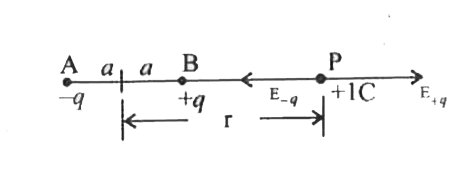 `|vecE|=((2pr)/(4piepsilon_0(r^2-a^2)))Vm^(-1)` `E=(2P)/(4piepsilon_0r^3)` for r > > a (for a short dipole) |
|