

Saved Bookmarks
| 1. |
Derive an expression for electric potential at a point due to a system of N charges. |
|
Answer» <P> Solution :Consider a system of charges `q_(1), q_(2),q_(3),cdots, q_(N)` with position vectors `r_(1) ,r_(2) .r_(3) ,cdots r_(N )`.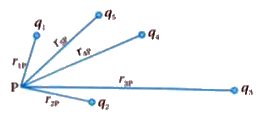 Electric potential at point P due to charge `q_(1)` `V_(1)=(kq_(1))/(r_(1)p)` where k is coulomb constant = `(1)/(4 pi in_(0))` and `r_(1)P` = distance between charge `q_(1)` and point P. Similarly electric potnetial due to charges `q_(2) , q_(3) cdots q_(N)` are `V_(2) = (kq_(2))/(r_(2)p), V_(3) = (kq_(3))/(r_(3)p)` and `V_(N)= (kq_(N))/(r_(NP))` Electric potential is a scalar quantity. HENCE total electric potential at P is, `V= V_(1)+V_(2)+V_(3)+, cdots, V_(N)` `:. V=k[(q_(1))/(r_(1P))+(q_(2))/(r_(2P))+(q_(3))/(r_(3P))+(q_(N))/(r_(NP))]` `:. N = k sum_(i=1)^(N)(q_(i))/(r_(iP))`where i =1,2,3, `cdots, ` N If `VECR` is the position vector of point P relative toorigin point and the position vectors `vecr_(1),vecr_(2),cdotsvecr_(n)`are of the charges `q_(1), q_(2), cdots , q_(N)` respectively then electric potential at point P, `V=ksum_(r=1)^(N)(q_(i))/((vecr-vecr_(i)))` where i=1,2,3 `cdots` N and `vecr_(iP)= (vecr-vecr_(i))` |
|