

Saved Bookmarks
| 1. |
Derive an expression for Ostwaid's dilution law. |
|
Answer» Solution :Ostwaid dilution law: It relates the dissocation constant of the WEAK ACID `(K_a)` with its degree of dissociation (a) and the concentration ( c). Considering a weak acid, the dissociation of ACETIC acid can be represented as `CH_3COOH LEFTRIGHTARROW CH_3COO^(-)+H^+` The dissociation constant of acetic acid is `K_a=([H^+][CH_3COO^-])/([CH_3COOH])` 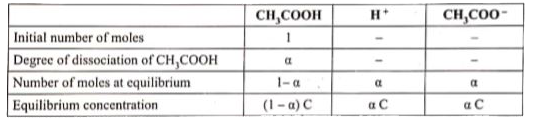 Substituting the equilibrium concentration in equation `K_a=((aC)(aC))/((1-a)C)impliesK_a=(a^2C^2)/((1-a)C)` `K_a=(a^2C)/((1-a))`.....(1) We know that weak acid dissociates only to a very small compared to one a is so small `therefore` equation (1) becomes `K_a=a^2C` `a^2=K_a/C implies a=sqrt(K_a/C)`....(2) Similarly for a weak base, `K_b=a^2C` `a=sqrt(K_b/C)` The concentration of `H^+` can be calculated using the `K_a` value as below `[H^+]=ac` `a=([H^+])/C` Substituting a value in equation (2) `([H^+])/C=sqrt(K_a/C)to[H^+]=sqrt(K_a/C).C` `[H^+]=sqrt((K_a.C^2)/C)implies[H^+]=sqrt(K_a.C)` For a weak base `[OH^-]=sqrt(K_b.C)` |
|