

Saved Bookmarks
| 1. |
Derive an expression for the difference in tensions at the highest and lowest points for a particle performing vertical circular motion. |
Answer» Solution :Consider a small BODY ( or particle) of mass m tied to a string and revolved in a vertical circle of radius r at a place where the accerleration due to graviy is g. At EVERY instant of its motion, the body is acted upon by TWO forces, namely, its weight `vec(mg)` and the tension `vecT` in the string.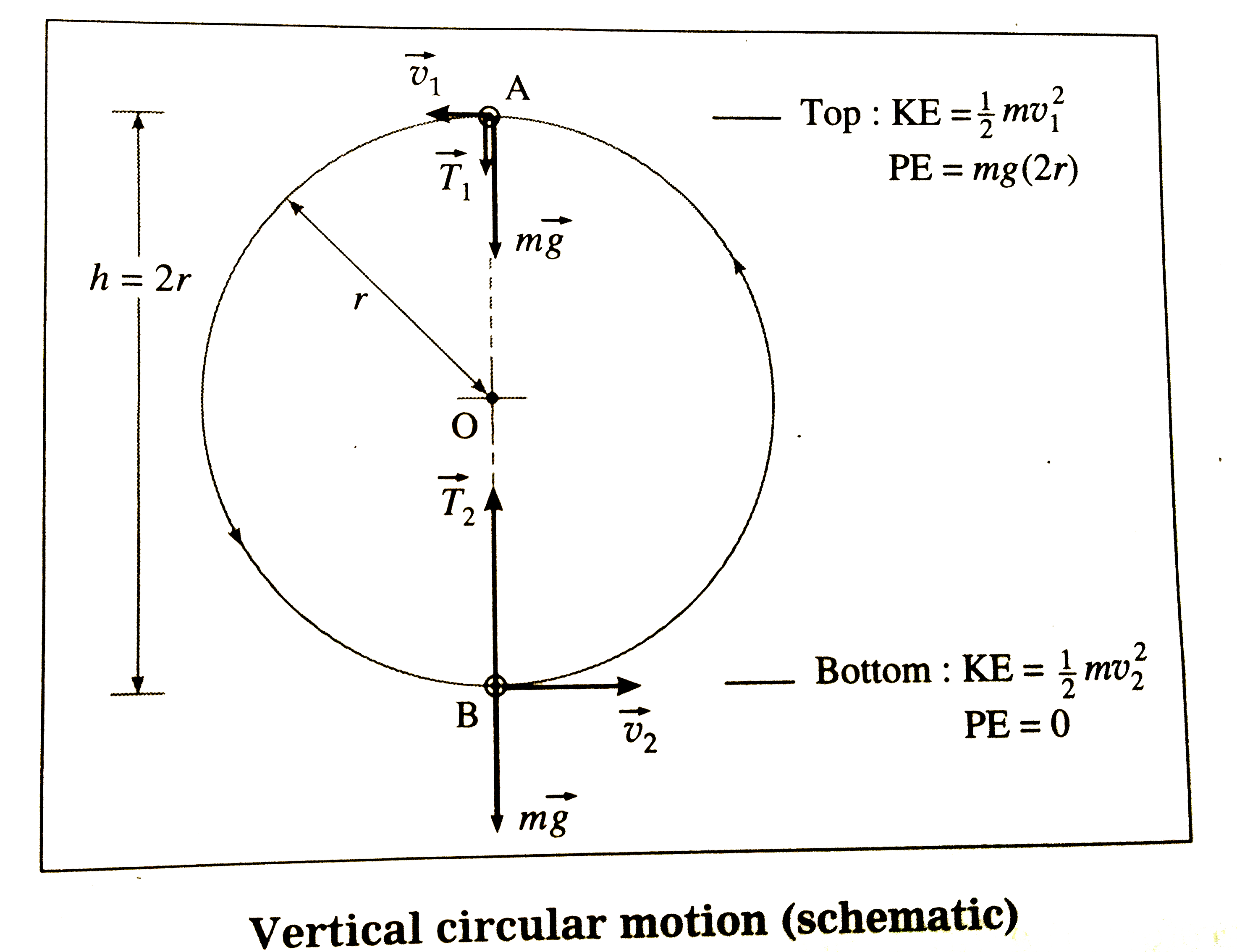 let `v_(2)` be the speed of body and `T_(2)` be the tension in the string at the lowest point B . We take the reference level for zero potential energy to be the bottom of the circle. THen, the body has only kinetic energy `(1)/(2)mv_(2)^(2)` at the lowest point. `therefore T_(2) = (mv_(2)^(2))/(r) + mg ""...(1)` and the total energy at the bottom ` = KE + PE = (1)/(2) mv_(2)^(2) + 0` ` = (1)/(2) mv_(2)^(2)""...(2)` Let `v_(1)` be the speed and `T_(1)` the tension in the string at the highest point A. As the body goes from B to A, it rises through a height h = 2r. `therefore T_(1)=(mv_(1)^(2))/(r) -mg""...(3)` and the total energy at A = KE + PE ` = (1)/(2) mv_(1)^(2) +mg(2r) ""...(4)` Thus, from Eqs. (1) and (3), `T_(2) -T_(1)=(mv_(2)^(2))/(r)+mg-((mv_(1)^(2))/(r)-mg)` ` = (m)/(r)(v_(2)^(2)-v_(1)^(2))+2mg""...(5)` Assuming that the total energy of the body is conserved, the totl energy at the bottom = total energy at the top Then, from Eqs. (2) and (4), ` (1)/(2)mv_(2)^(2)=(1)/(2)mv_(1)^(2)+mg(2r)` `thereforev_(2)^(2)-v_(1)^(2)=4gr""...(6)` Substituting this in Eq. (5), `T_(2)-T_(1)=(m)/(r)(4gr)+2mg` ` =4mg+2mg` = 6 mg Therefore, the difference in the TENSIONS in the string at the highest and the lowest points in 6 times the weight of the body. |
|