

Saved Bookmarks
| 1. |
Derive an expression for the impedance of a series LCR circuit, when an AC voltage is applied to it. |
Answer» Solution :Consider a RESISTANCE R, an inductor of self inductance L and a capacitor of capacitance C connected in series across an AC source.The applied voltage is given by, `v=v_0 sin omegat` …(1) 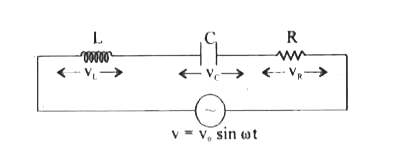 where, `v_0` is the instantaneous value, v. is the peak value and `omega = 2pif`, f being the frequency of AC. If i be the instantaneous current at time t, the instantaneous VOLTAGES across R, L and Care respectively iR, `iX_L` and `iX_C`. The vector sum of the voltage amplitudes across R, L, C EQUALS the amplitude `v_0` of the voltage applied. Let `v_R,v_L` and `v_C` be the voltage amplitudes across R, L and C respectively and `I_0` the current amplitude. Then `v_R=i_0R` is in phase with `i_0`. `v_L=i_0 X_L=i_0 (omegaL)`leads `i_0` by `90^@` `v_c=i_0X_C=i_0 (1/(omegaC))` lags behind`i_0` by `90^@` .  The current in a pure resistor is phase with the voltage, whereas the current in a pure inductor lags the voltage by `pi/2` rad. The current in a pure capacitor leads the voltage by `pi/2` rad. For`V_L > V_C`, phase angle `phi` between the voltage and the current is positive. From the RIGHT angled triangle OAP, `OP^2 = OA^2 +AP^2 =OA^2+ OB^2 (becauseAP=OB)` `=v_R^2 +(v_L-v_C)^2` `=(iR)^2 + (iX_L - iX_C)^2` `=i^2 (R^2 + (X_L -X_C)^2)` `therefore i=v/sqrt(R^2 + (X_L -X_C)^2)=v/Z` and `Z=sqrt(R^2 + (X_L -X_C)^2)` Where Z is the impedance of the circuit Phase angle between v & i. `tan phi =(v_L-v_C)/v_R =(X_L-X_C)/R_L` `phi=tan^(-1) ((X_L-X_C)/R)` |
|