

Saved Bookmarks
| 1. |
Derive expresion for capacitance of a parallel plate capacitor and explain the combination of capacitors in series. Or. Write expression for three capacitors in series and parallel combinations. |
|
Answer» Solution :Capacitors in Series. Capacitors are said to be connected in series when charge proceeds from one point to the other through a single path. If figure `C_(1),C_(2), . . ,C_(n)` etc, are connected in series. Let CAHRGE +q be given to the left plate of `C_(1)`, a charge-q is induced on inner side of right plate of `C_(1) and +q` on the outer side of this plate. charge thus flows from left to rightl. let `V_(1),V_(2),. . .V_(n)` be the potential differences between two sides of `C_(1),C_(2), . . ,C_(n)` respectively V be the total P.D. across all the plates. 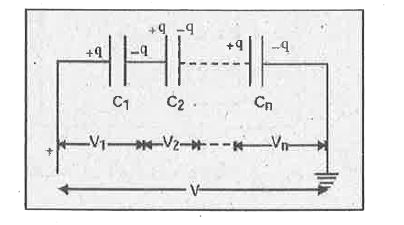 `therefore V_(1)=(q)/(C_(1)),V_(2)=(q)/(C_(2)), . . .,V_(n)=(q)/(C_(n)) and V=(q)/(C_(s))` where `C_(s)` is the resultant CAPACITANCE of the arrangement in series. Now `V=V_(1)+V_(2)+ . .+V_(n)` or `(q)/(C_(s))=(q)/(C_(1))+(q)/(C_(2))+ . .+(q)/(C_(n))` or `(1)/(C_(s))=(1)/(C_(1))+(1)/(C_(2))+ . .. +(1)/(C_(n))` NOTE: if we have two capacitors of capacitance `C_(1) and C_(2)`, then `(1)/(C_(s))=(1)/(C_(1))+(1)/(C_(2))` Capacitors in parallel. capacitors are said to be connected in parallel if the .positively charged. plates of all the capacitors are connected together at a point A while the .earthed. plates are connected together at another point B. the point B is also connected to earth while the source of charge is connected between the points A and B (fig). 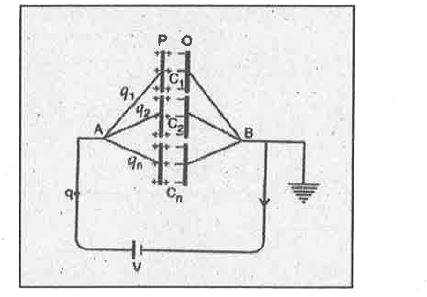 Capacitors having capacities `C_(1),C_(2), ... ,C_(n)`, draw charges `q_(1),q_(2), . . . ,q_(n)` in ACCORDANCE with their capacities. if q is the total charge drawn from the source, then `q=q_(1)+q_(2)+ . . .+q_(n)`. . (1) Since all the capacitors are connected between two COMMON points A and B therefore, the potential difference across each of them is the same i.e. V. this is also the potential difference across the two terminals of the source of charge. When `q_(1)=C_(1)V`, `q_(2)=C_(2)V`, . . . . . . . .. . . . . . . . `q_(n)=C_(n)V`. If `.C_(p).` is the capacity of the combination, then `V=(q)/(C)` or `q=CV` Putting the values of `q,q_(1),q_(2), . ..,q_(n)` in Eq. (i), we get `CV=C_(1)V+C_(2)V+ . . .+C_(n)V` or `C_(p)=C_(1)+C_(2)+ ... . +C_(n)` Note. For three capacitors, we shall use only three capacitors `C_(1),C_(2) and C_(3)`, then `(1)/(C_(s))=(1)/(C_(1))+(1)/(C_(2))+(1)/(C_(3))` and `C_(p)=C_(1)+C_(2)+C_(3)`. |
|