

Saved Bookmarks
| 1. |
Derive the expression for force per unit length between two long straight parallel current carrying conductors. Hence define one ampere. |
|
Answer» Solution :Force between two parallel CURRENT carrying wires: AB and CD are two infinitely long CONDUCTORS, placed parallel to each other and separated by distance r. They carry current `I_(1) and I_(2)` in the same direction. Magnetc field produced by current `I_(1)` at any point on CD is `B_(1) = (mu_(0)I_(1))/(2pir)` This field acts perpendicular to CD and into the plane of paper. It exerts a force on wire CD carrying current `I_(2)` is `F = B_(1) I_(2) l` `F = (mu_(0))/(2pir) xx I_(2). I_(2) l rArr F = (mu_(0))/(2pi).(I_(1)I_(2))/(r).l` `:.` Force PER unit length is `F = (mu_(0))/(2pi).(I_(1)I_(2))/(r) " " :. F = (mu_(0))/(4pi).(I_(1)I_(2))/(r)` 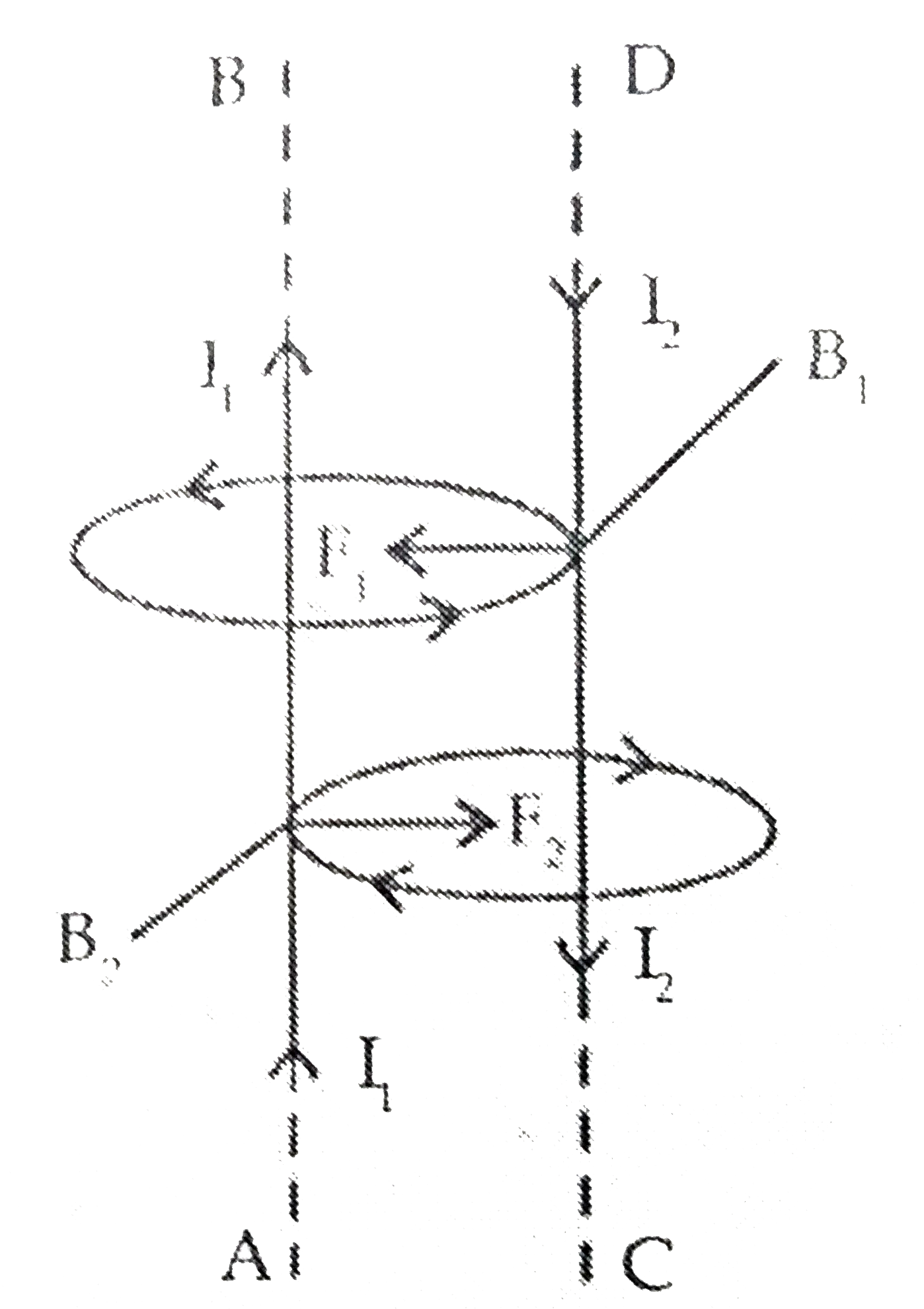 By Fleming's left hand rule, this force will be attractive Definition of ampere: Let `I_(1) = I_(2) = I A, r = 1m` then `F = (4pi xx 10^(-7) xx 2 xx 1 xx 1)/(4pi xx 1) " " [ :' mu_(0) = 4pi xx 10^(-7)]` `F = 2 xx 10^(-7) N` Thus, one amplere is that much current which when flowing through each of the two parallel uniform long linear conductors placed in free space at a distance of one metre from each other will attract or repel each other with a force of `2 xx 10^(-7)N` per metre of their length. Pattern of magnetic field : The pattern of the magnetic field indicates the force of attraction between two parallel conductors carrying current in the same direction (FIG .a) and force of repulsion between two parallel conductors carrying current in opposite direction (Fig.b) 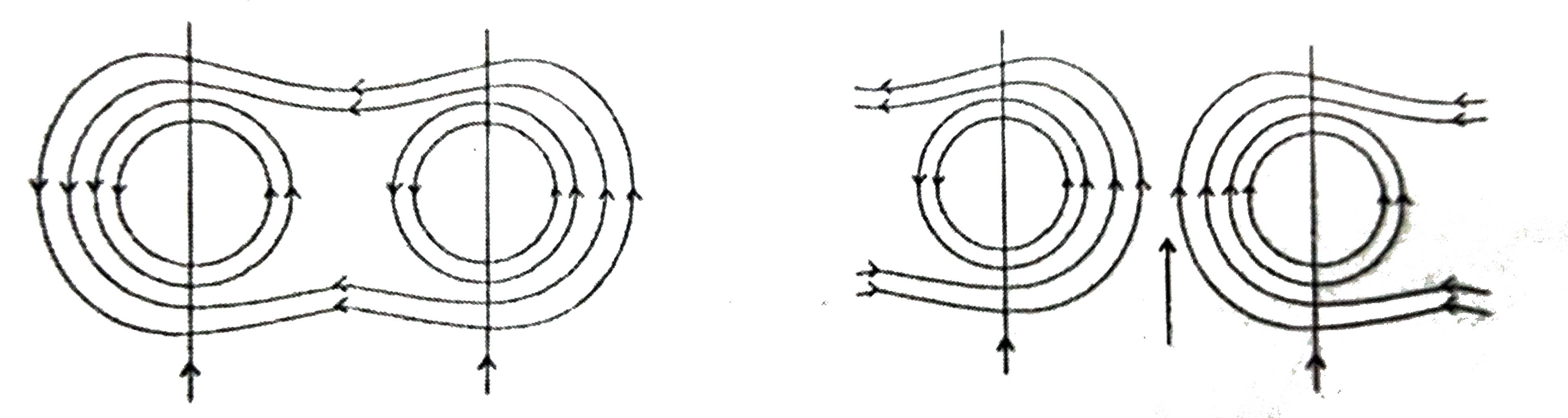
|
|