

Saved Bookmarks
| 1. |
Derive the expression for the intensity at a point where interference of light occurs. Arrive at the conditions for maximum and zero intensity, |
|
Answer» Solution :Let `y_(1) and y_(2)` be the displacements of the two waves having same amplitude a and `phi` is the PHASE difference between them. `y_(1) =a sin omegt....(1)` `y_(2)=a sin (omegat+phi)....(2)` The resultant displacement `y=y_(1)+y_(2)` `y=a sin omegat+a sin (omegat+phi)` `y=a sin omegat+a sin omegat cos phi+a cos omegat sin phi` `y=a sin omegat [1+cos phi]+cos omegat (a sin phi)`....(3) Let `R cos theta=a(1+cos phi).....(4)` `R sin phi=a sin phi ....(5)` `y=R sin omegat. cos theta+R cos omegat, sin OMEGA` `y=R sin (omegat+theta).....(6)` where R is the resultant amplitude at P, squaring equations (4) and (5), then adding `R^(2)[cos^(2) theta+sin^(2) theta]=a^(2) phi+2 cos phi+sin^(2)phi]` `R^(2)[1]=a^(2)[1+1+2 cos phi]` `I=R^(2)=2a^(2)[1+cos phi]=2a^(2)xx2cos^(2) (phi)/(2), I=4a^(2) cos^(2) (phi)/(2)` ......(7) (i) Minimum intensity `(I_(max))` `cos^(2) (phi)/(2)=1` `phi=2npi, "Where "n=0,1,2,3,......` `phi=0,2pi,4pi,6pi` `THEREFORE I_(max)=4a^(2)` (ii) Minimum intensity `(I_(min))` `cos^(2) (theta)/(2)=0` `phi=(2n+1)pi" where "n=0,1,2,3,......` `phi=pi,3pi,5pi,7pi......` `I_(min)=0`. 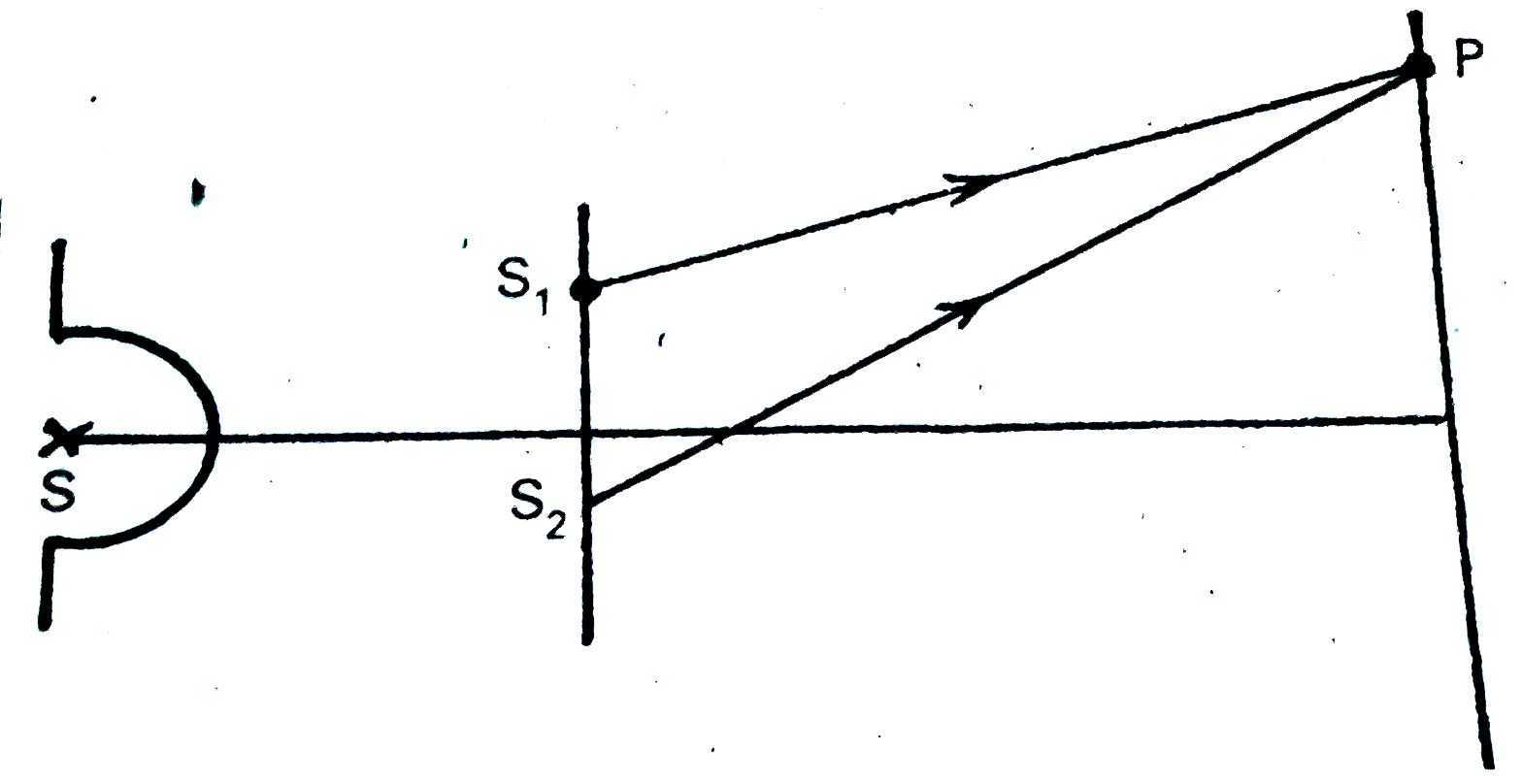
|
|