

Saved Bookmarks
| 1. |
Derive the expression for the radius of the orbit of the electron and its velocity using Bohr atom model. |
|
Answer» Solution :Radius of the orbit of the electron and velocity of the electron : Consider an atom which contains the nucleus at rest and an electron revolving around the nucleus in a circular orbit of radius `r_n` as shown in figure. Nucleus is made up of protons and neutrons. Since proton is positively charged and neutron is electrically neutral, the CHARGE of a nucleus is PURELY the total charge of protons. LET Z be the atomic number of the atom, then +Ze is the charge of the nucleus. Let -E be the charge of the electron. From Coulomb.s law, the force of attraction between the nucleus and the electron is `vecF_"COLOUMB"=1/(4piepsilon_0)((+Ze)(e))/r_n^2 hatr` `=-1/(4piepsilon_0) (Ze^2)/r_n^2 hatr` This force provides necessary centripetal force `vecF_"centripetal"=(mv_n^2)/r_n hatr` where m be the mass of the electron that moves with a velocity `v_n` in a circular orbit. Therefore , `|vecF_"coloumb"|=|vecF_"centripetal"|` `1/(4piepsilon_0)(Ze^2)/r_n^2 =(mv_n^2)/r_n` `r_n=(4piepsilon_0(mv_nr_n)2)/(Zme^2)`...(1) From Bohr.s assumption, the angular momentum quantization condition,`mv_n r_n=I_n = n_h`. `therefore r_n=(4piepsilon_0 (mv_n r_n)^2)/(Zme^2)` `r_n=(4piepsilon_0 (nh)^2)/(Zme^2) =(4piepsilon_0 n^2h^2)/(Zme^2)` `r_n=((epsilon_0h^2)/(pime^2))n^2/Z (therefore h=h/(2pi))` ...(2) where n `in NN`. Since `epsilon_0 , h,e` and `pi` are constants.Therefore , the radius of the orbit becomes `r_n=a_0 n^2/Z` where `a_0=(epsilon_0h^2)/(pime^2)`=0.529 Å. This is known as Bohr radius which is the smallest radius of the orbit in an atom . Bohr radius is also used as unit of length called Bohr. 1Bohr =0.53 Å.For hydrogen atom (Z=1) ,the radius of `n^(th)` orbit is `r_n=a_0n^2` For the first orbit (ground state ), `r_1=a_0`=0.529 Å For the second orbit (first excited state), `r_2=4a_0`=2.116 Å For the third orbit (second excited state) , `r_3=9a_0`=4.761 Å and so on. Thus the radius of theorbit from centre increases with n, this is `r_n prop n^2` as shown in figure .Further, Bohr.s angular momentum quantization conditionleads to `mv_n r_n =mv_n a_0 n^2=n h/(2pi)` `v_n=h/(2pima_0)Z/n` `v_n prop 1/n` Note that the velocity of electron decreases as the principal quantum number increases as shown in figure. This curve is the rectangular hyperbola. This implies that the velocity of electron in ground state is maximum when compared to excited states. 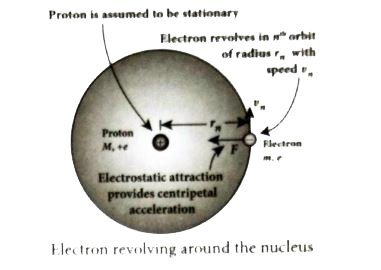 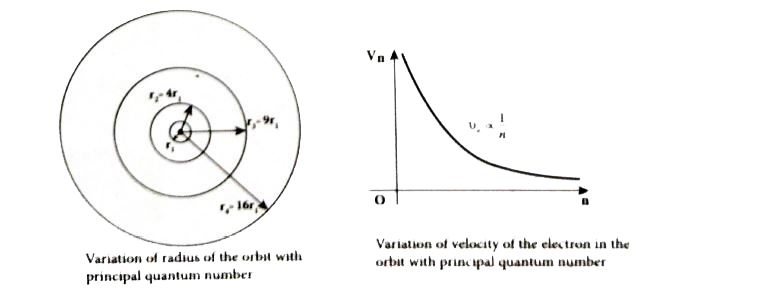
|
|