

Saved Bookmarks
| 1. |
Derive the formula for the electric potential due to an electric dipole at a point from it. |
|
Answer» Solution :A dipole is placed with ORIGIN at its midpoint. Its charge -q and +q is separated by a distance 2a. The magnitude of a dipole moment of the dipole is p= 2aq and its direction is from -qto +q. Let point P away from the midpoint of dipole and `r_(1)` and `r_(2)` are the distance of P from +q and q respectively which is shown in the figure . 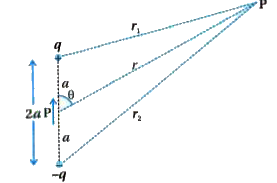 The potential DUE to the charge +q at point P is `V_(1) (k(+q))/(r_(1))`and The potential due to the charge -q, `V_(2)=(k(-q))/(r_(2))= (kq)/(r_(2))` According to superposition principle, the total potential at point P `V=V_(1)+V_(2)` `=(kq)/(r_(1))-(kq)/(r_(2))` `=kq [(1)/(r_(1))-(1)/(r_(2))]` DRAW qN `bot` OP In `DeltaqON angleqON = theta` `:. ON = r- r_(1)` and `COS theta= (ON)/(Oq) implies ON = Q q cos theta` `:. r- r_(1) = a cos theta implies r_(1) = r - a cos theta ` `=r(1-(a_(r1))/(r) cos theta)` `implies r_(1)^(2)= r^(2) (1-(a)/(r)cos theta)^(2)` `=r^(2)(1-""(2acostheta)/(r)+(a^(2))/(r^(2))cos^(2)theta)` `=r^(2)(1-(2acostheta)/(r))` Putting `rgtgt a implies (a^(2))/(r^(2))=0` and draw OM `bot` (-qp=P) then in `Delta- ` qOM P(-q) M `= theta` and (-q) M `= r_(2) -r ` `:. cos theta((-q)M)/(O-(-q))implies (-q)M =m O (-q) cos theta` `:. r_(2) -r = acostheta` `:> r_(2) = r +a cos theta` `:. r_(2)= r(1+(a)/(r) cos theta)` Similarly `r_(2)^(2) =r^(2) (1+(2acostheta)/(r))` Now from equation (4 ) `:. (1)/(r_(1))=(1)/(r)(1-(2acostheta)/(r))^(-1//2)` `=(1)/(r)(1+(acostheta)/(r))` only two terms be taken from expansion and, `(1)/(r_(2))=(1)/(r)(1-(acostheta)/(r))` Now from equation (5) only two terms be taken from expansion . `implies` Putting the values of equation (6) and (7) in equation (1) , `V=(kq)/(r)[(1+(acostheta)/(r))-(1-(acostheta)/(r))]` `=(kq)/(r)[(2acostheta)/(r)]` `=(k(p)costheta)/(r^(2)) [ because 2aq=p]` `=(kvecP.vecr)/(r^(2))[becausep costheta= vecP.hatr]` `:. V = (p.hatr)/(4piin_(0)r^(2))or (pcostheta)/(4piin_(0)r^(2))or (kpcostheta)/(r^(2))` Hence potential due to a point charge decreases according `(1)/(r)` and potential due to a dipole decreases according to `(1)/(r^(2))` distance . The molecular dipoles are very small and such an approximation is very WELL applicable to them. |
|