

Saved Bookmarks
| 1. |
Derive the formula for the electric potential energy of system of three charges. |
|
Answer» Solution :Let charge `q_(1),q_(2)` and `q_(3)` are bring from infinity distance to at the point `P_(1), P_(2)` and `P_(3)`, located at distance `r_(1),r_(2)` and `r_(3)` respectively. All three charges are brought as shown in FIGURE. 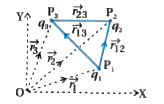 To bring `q_(1)` first from infinity to `P_(1)`, the work done`W_(1)=0` because there is no external force to bring `q_(1)` to `P_(1)` Electric potential at `P_(2)` due to charge `q_(1)` `V_(1)= (kq_(1))/(r_(12))` Now work done to bring charge `q_(2)` at point `P_(2)` `W_(2)=V_(1)xxq_(2)` `:. W_(2)=(kq_(1)q_(2))/(r_(12))` Electric potential at Pz due to charge `q_(1) + q_(2)` `V_(2)=(kq_(1))/(r_(13))+(kq_(2))/(r_(23))` `:.` Work done to bring charge `q_(3)` to `P_(3)` `W_(3)` potential at `P_(3)` due to `q_(1)+q_(2)xxq_(3)` charge `=k[(q_(1))/(r_(13))+(q_(2))/(r_(23))]xxq_(3)` `=k[(q_(1)q_(3))/(r_(13))+(q_(2)q_(3))/(r_(23))]` `:.` OTAL potential energy of charges `q_(1)+q_(2)+q_(3)` `U=W_(1)+W_(2)+W_(3)` `[ because` Electric force is conservative and hence W U] `:. U=k[0+(q_(1)q_(2))/(r_(12))+(q_(1)q_(3))/(r_(13))+(q_(2)q_(3))/(r_(23))]` `:. U=k[(q_(1)q_(2))/(r_(12))+(q_(1)q_(3))/(r_(13))+(q_(2)q_(3))/(r_(23))]` Equation (3) is true for any sign of `q_(1)` and `q_(2 )` If `q_(1) q_(2) gt 0 ` potential energy will be positive. And if `q_(1)q_(2) lt 0`potential energy will be negative. |
|