

Saved Bookmarks
| 1. |
Derive the relation between the linear velocity and the angular velocity of a particle in circular motion. A conical pendulum has length 1 m and the angle made by thestring with the vertical is10^(@) . The mass of thebob is 100 g .Find the tension in hte string. |
Answer» Solution :Consider a particle performing circular motion in an anticlockwise sense, along a circle of radius r as shown in thefigure. In a very small time interval `delta t`, the particle MOVES from point A to point B through a distance `delta s` and its angular POSITION changes by ` delta theta`. 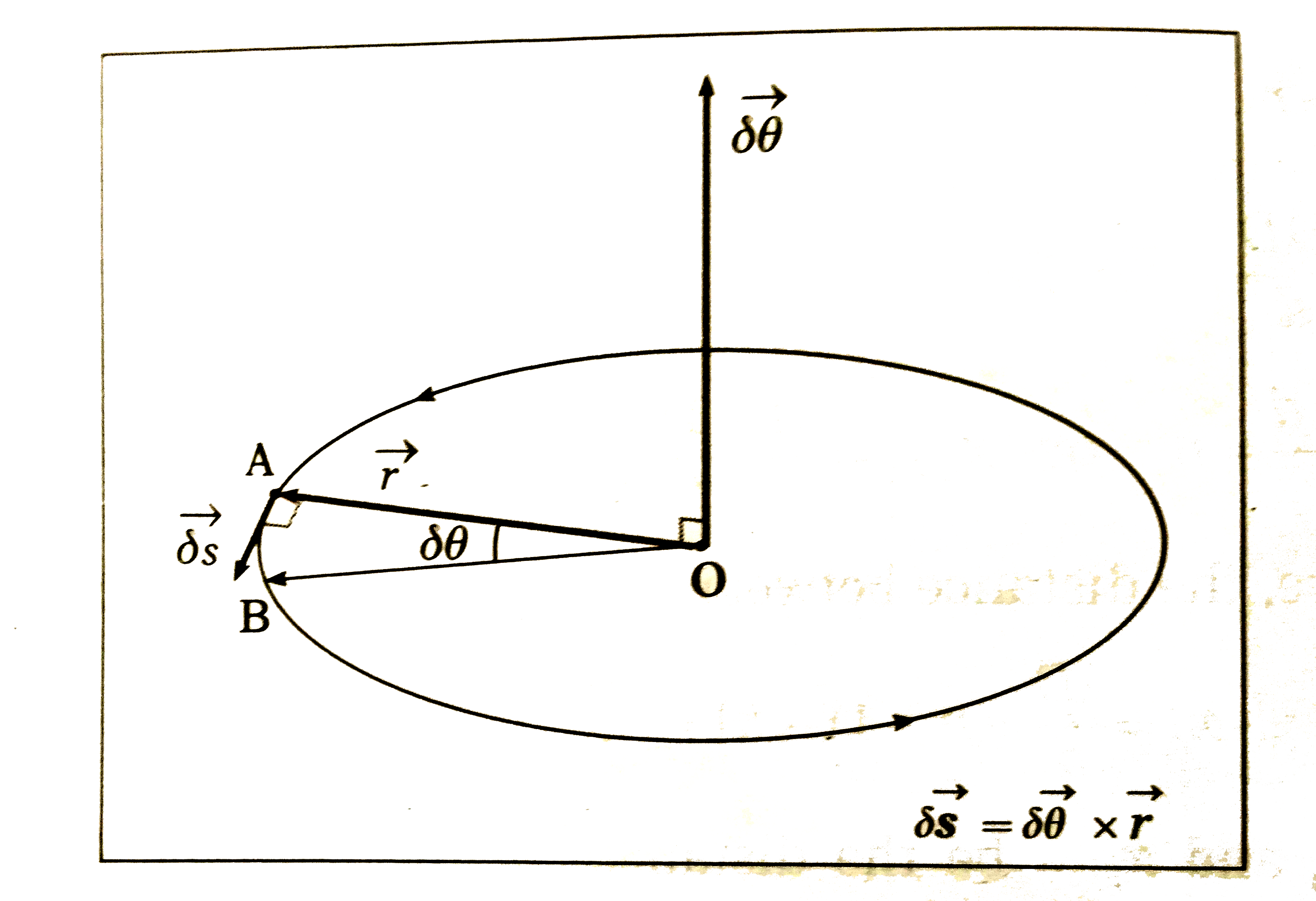 ` delta theta = (arc AB)/("radius") = (deltas)/r` As ` deltat to 0`, point B will be very close to A and the displacement `vec(AB) = vec(delta s) ` will be a straight line perpendicular to radius vector `vec(OA)= vecr`. By right hand rule of cross product, `vec(deltas) = vec(deltatheta) xx vecr` ` :.underset(deltat to 0)"lime" (vec(deltas))/(deltat) = (underset(deltat to 0)"lime" (vec(deltatheta))/(deltat))xx vecr` ` :. vec(d s)/(dt) = vec(d theta)/(dt) xx vecr`...(1) The linear velocity `vecv` of the particle is the time RATE of displacementand its angular velocity `vec omega` is the time rate of angular displacement. `:. vecv = (vec(ds))/(dt) andvecomega = vec(d theta)/(dt)` Therefore, from EQ. (1) , `vecv= vec omega xx vec r` Since ds is tangential, the instantaneous linear velocity `vecv` of a particle performing circular motion is along the tangent to thepath, in the sense of motion of theparticle . `vecv, vec omega and vec r` are mutuallyperpendicular, so that in magnitude , v =` omega r`. Data : ` L = 1 m, theta = 10^(@) , m = 0.1 kg , g = 9.8 m//s^(2)` The tension in thestring, ` F = (mg)/(cos theta)` ` = (0.1 xx 9.8)/(cos 10^(@))` ` = (0.98)/(0.9848) = (9.8)/(9.848)` ` = 0.9949` N `{:(log 9.8,," "0.9912),(log 9.848,,ul(-0.9934)),(,,ul(" "bar(1).9978)):}` AL ` bar(1).9978 = 0.9949` |
|