

Saved Bookmarks
| 1. |
Describe a method to determine Young's modulus of the material of a thin wire. |
|
Answer» Solution :Apparatus : The experimental wire B is suspended from a rigid wallsupport along with a compensating or reference wire A of the same length, material and cross section. A manin SCALE is attached to the wire A. Avernier scale attached to the wire B can move alongside the main scale. A dead load is attached to the compensating wire to keep it taut. Slotted WEIGHTS may be added to a hanger attached to the experimental wire. 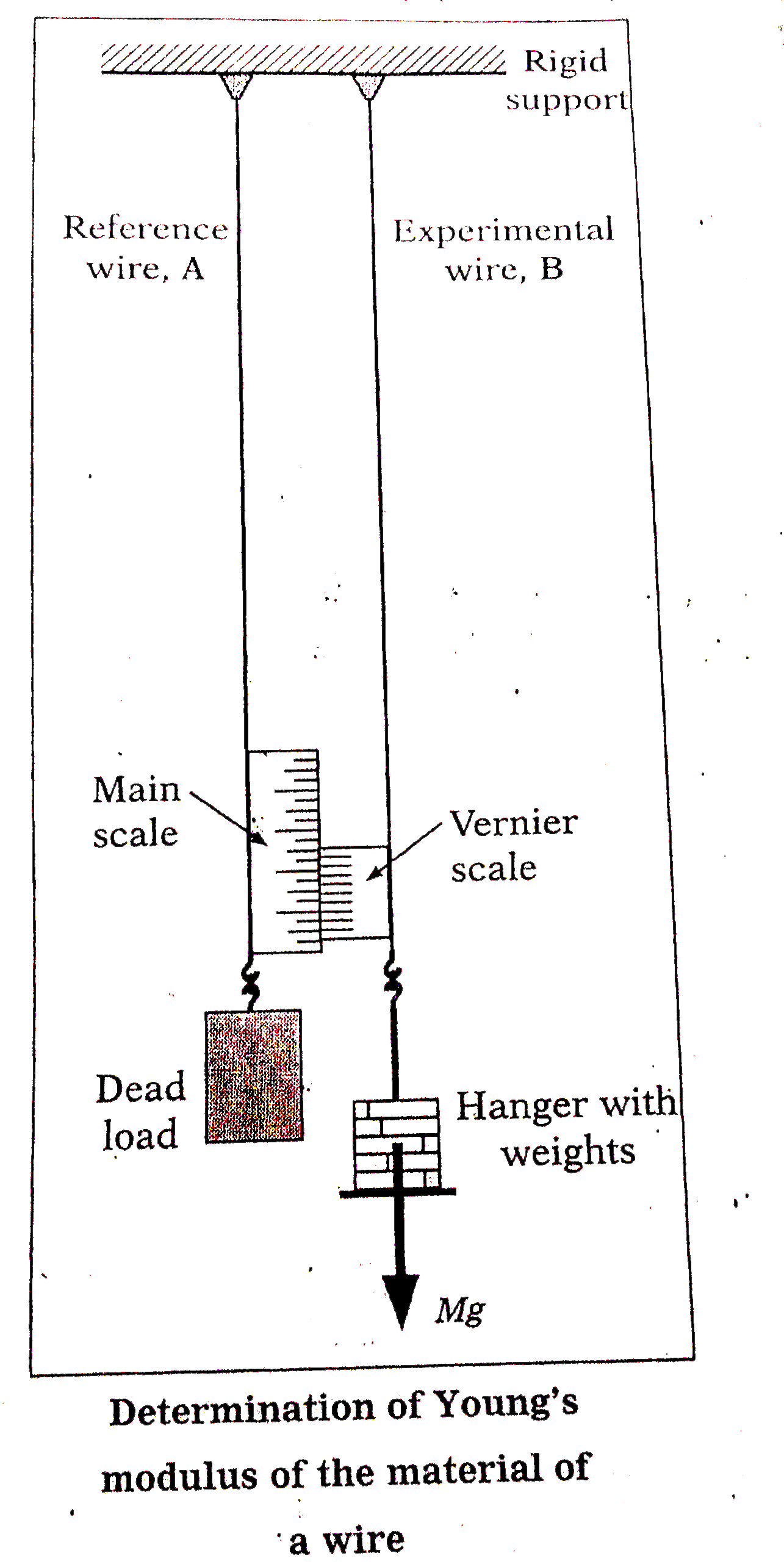 Procedure: (1) The length L and radius r of the experimental wire are measured. (2) The experimental wire is initially loaded with 1 kg to 2 kg to keep it taut and free from kinks. It is treated as a zeroload. The main scale and Vernier scale readings are noted as those for zero-load. (3) The stretching load Mg on the experimental wire is increased by 0.5 kg at a time. the scale readings are noted for each increase in load, after allowing SUFFICIENT time for the wire to elongate. (4) After 6-8 such readings, the wire is unloaded 0.5 kg at a time, and the corresponding scale readings are noted. Within limits of experimental error, the readings for the same load-while loading and unloading- should be the same. (5) The average ELONGATION per unit mass, `DeltaL//M` is found. (6) Young's modulus of the material of the wire is calculated using the formula `Y=("longitudinal stress")/("longitudinal strain") =(Mg//pir^(2))/(Delta L//L)=(gL)/(PI r^(2) (DeltaL//M))` |
|