

Saved Bookmarks
| 1. |
Describe the electrolysis of molten NaCl using inert electrodes. |
|
Answer» Solution :The electrolytic cell consists of two iron electrodes dipped in molten sodium choride and they are connected to an external DC POWER supply via a key. The electrode which is attached to the negative end of the power supply is called the cathode and the one is which attached to the positive end is called the anode. Once the key is closed, the external DC power supply drives the electrons to the cathode and at the same time pull the electrons from the anode. Cell REACTIONS : `Na^(+)` ions are attracted TOWARDS cathode,where they combines with the electrons and reduced to liquid sodium. Cathode (reduction) `Na_((l))^(+)+e^(-)Na_((l))""E^(@)=-2.71V` Similarly, `Cl^(-)` ions are attracted towards anode where they losses their electrons and oxidised to chlorine gas. Anode (oxidation) `2Cl_((l))^(-)rarr Cl_(2(g))+2e^(-)""E^(@)=-1.36V` The overall reaction is , `2Na_((l))^(+)+2Na_((l))+Cl_(2(g))""E^(@)=4,07V` 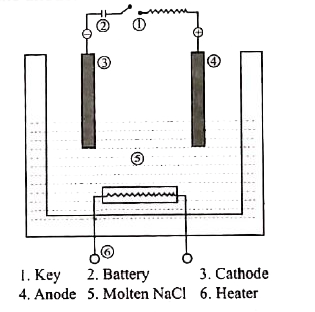 The negative `E^(@)` value shows that the above reaction is a non SPONTANEOUS one. HENCE, we have to supply a voltage greater than 4.07V to cause the electrolysis of molten `NaCl`. In electrolytic cell, oxidation occurs at hte anode and reduction occurs at the anode and reduction and reduction occur at the cathode as in a galvanic cell, but the sign of the electrodes is the reverse i.e.m in the electrolytic cell cathode is `-ve` and anode is `+ve`. |
|