

Saved Bookmarks
| 1. |
Describe the microscopic model of current and obtain general from of Ohm's law. |
Answer» Solution :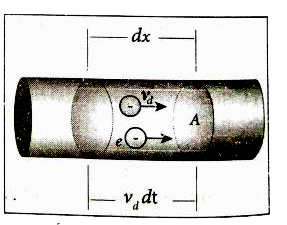 Microscopic model of current: Consider a conductor with area of cross-section A and an electric field `vecE` applied from right to left. Suppose there are n electrons PER unit volume in the conductor and assume that all the electrons move with the same drift velocity `vecv_(d)`. The drift velocity of the electrons `=v_(d)` The electrons move through a DISTANCE dx within a small interval of dt `v_(d)=(dx)/(dt), dx=v_(d)dt ""... (1)` SINCE A is the area of cross section of the conductor, the electrons AVAILABLE in the volume or length dx is = volume `xx` number per unit volume `=adx xx n "" ...(2)` Substituting for dx from equation (1) in (2) `=(A v_(d)dt)n` Total charge in volume element `dQ=` (charge) `xx` (number of electrons in the volume element) `dQ=(e ) (A v_(d)dt)n` Hence the current, `I=(dQ)/(dt)=(n eAv_(d)dt)/(dt)` `I=n eAv_(d)"" ...(3)` Current density (J): The current density (J) is defined as the current per unit area of cross section of the conductor `J=(1)/(A)` The S.I. unit of current density, `(A)/(m^(2))(or) Am^(-2)` `J=(n eAv_(d))/(A)` (from equation 3) `J=n ev_(d)"" ...(4)` the above expression is valid only when the direction of the current is perpendicular to the area A. In general, the current density is a vector quantity and it is given by `vecJ= n e vecv_(d)` Substituting `vecv_(d)` from equation `vecv_(d)=(-e tau)/(m) vecE ` `vecJ= -(n.e^(2)tau)/(m)vecE "" ...(5)` `vecJ= -sigma vecE` But conventionally, we take the direction of (CONVENTIONAL) current density as the direction of electric field. So the above equation becomes `vecJ=sigma vecE` where `sigma (n e^(2)tau)/(m)` is called conductivity. The equation 6 is called microscopic form of ohm.s law. |
|