

Saved Bookmarks
| 1. |
Describe with a neat diagram Quinche's method to demonstrate interference of sound waves and to determine the wavelength and speed of the sound waves. |
Answer» Solution :Quincke's tube consists of two glass U-tubes, A and B as shown in the figure. Tube A has two openings at S and E, and is held fixed. Tube B can be slided in or out of tube A. A source of SOUND, e.g., a vibrating tuning fork, is held at S and the ear is hel against the opening E. 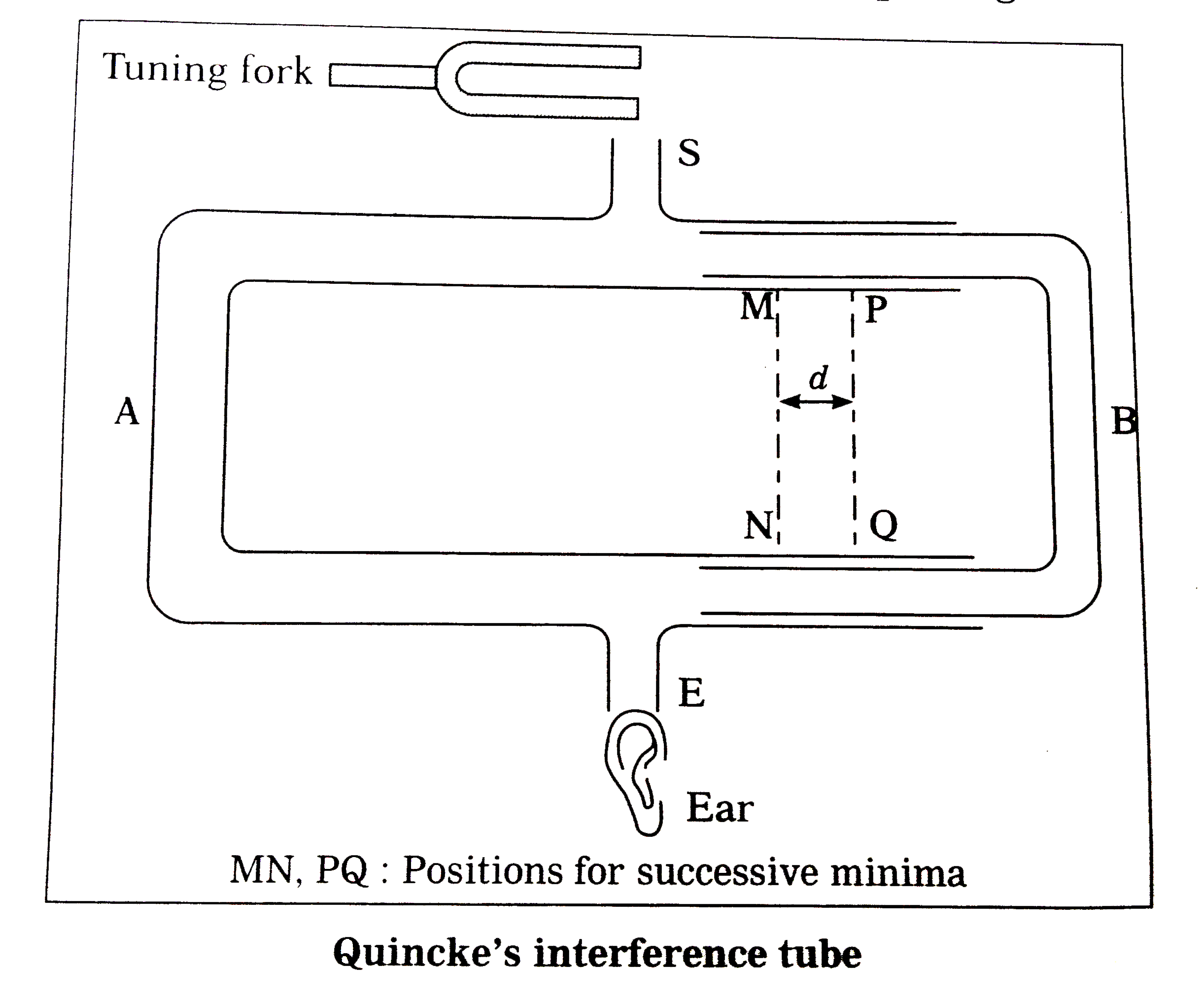 Sound waves from S arrive at E travelling along the paths SAE and SBE. Since these two waves are derived from the same source S, they are coherent. When the two paths are equal or differ by a whole NUMBER of wavelengths, the waves meet at the end E in phase. then the listener HEARS a loud sound corresponding to constructive interference. Drawing out the tube B slowly, the sound dies away and becomes a minimum when the path difference, `SBE-SAE`, is `lambda//2`, where `lambda` is the wavelength of the sound. Then, the waves meeting at E are in opposite phase to each other, cancelling each other out in destructive interference. If the tube B is drawn further out by an equal distance, the path difference will be one wavelength and the loud sound reappears. If the next minimum (say, PQ) is d, then the wavelength `lambda=2d`. the SPEED of sound in air is `v=n lambda`, where n is the frequency of the source S. Thus, the wavelength of the sound can be obtained by measuring d, and the speed of sound can be determined when a source of known frequency is used. |
|