

Saved Bookmarks
| 1. |
Describe Young's double slitexperiment to produce interference pattern due to a monochromatic source of light. Deduce the expression for the fringe width. |
|
Answer» Solution :Simplest experiment to show interference of LIGHT is Young's double slit experiment : `DELTA` is a narrow slit (of width about 1 mn) illuminated by a monochromatic source of light. At a suitable distance (`~~10mm`) form `delta," two slits " S_1 and S_2` are placed PARALLEL to S. When a screen is placed at a large distance (about 2m) from the slit `S_1 and S_2`, alternate dark and bright bands appear on the screen. These are the interference bands or fringas. The bond disappear when either slit is covered. Explanation : According to Huygen's pricipal, the monochromatic source of light illuminating the slit S tends out spherical wavefront. The two waves of same amplitude and same freqency superimpose on each other. Dark fringes appear on the screen when the crest of one wave falls on the trough of other and they neutralise the effect of each other. Bright fringes appear on the screen when the crest of one wave coincides with the crest of other and they reinforce each other. Expression for the fringe width : Let d= distance between slits `S_1 and S_2` D= distance of screen from two slits and x = distance between the central maxima O and OBSERVATION point P. 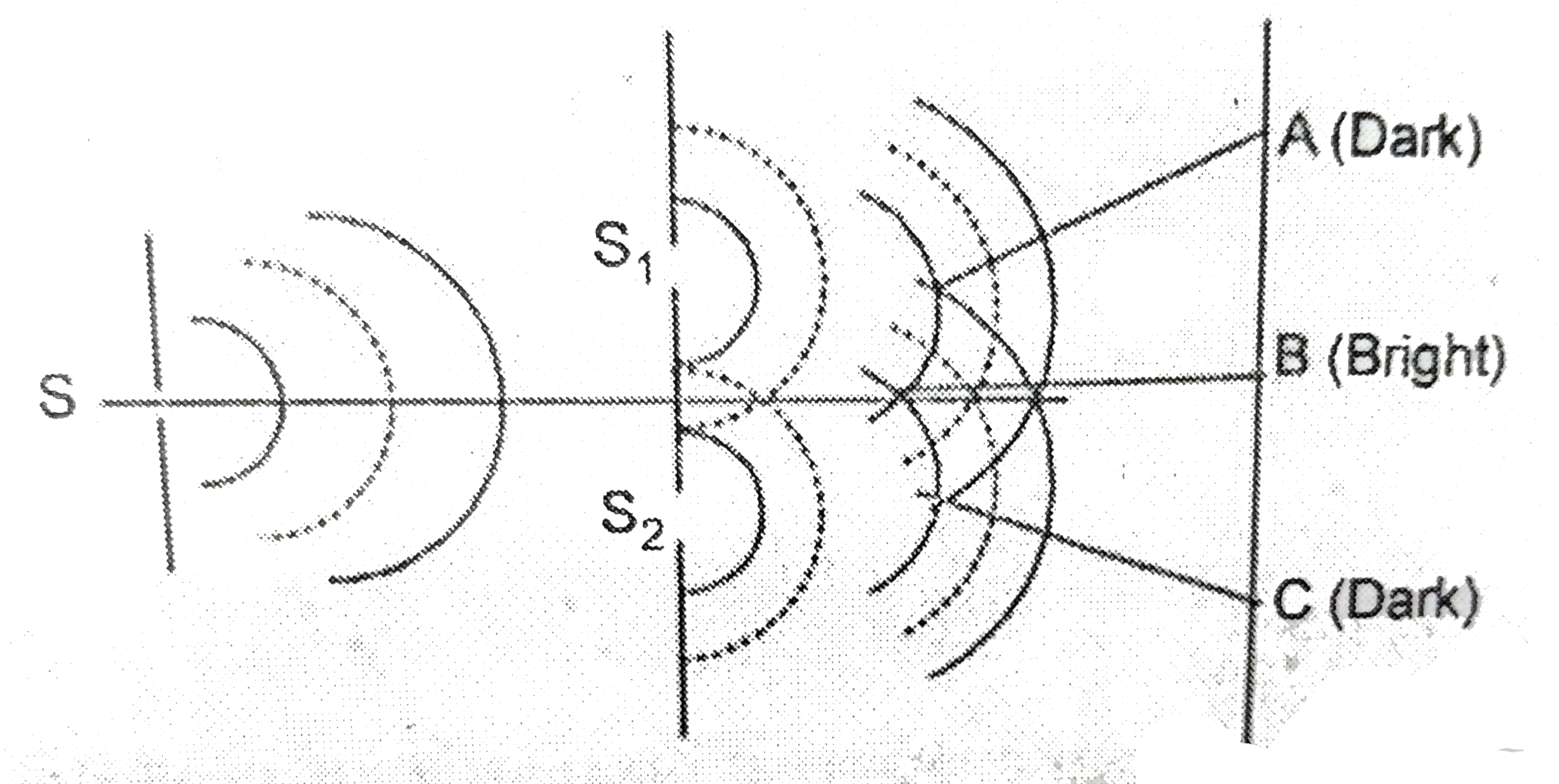 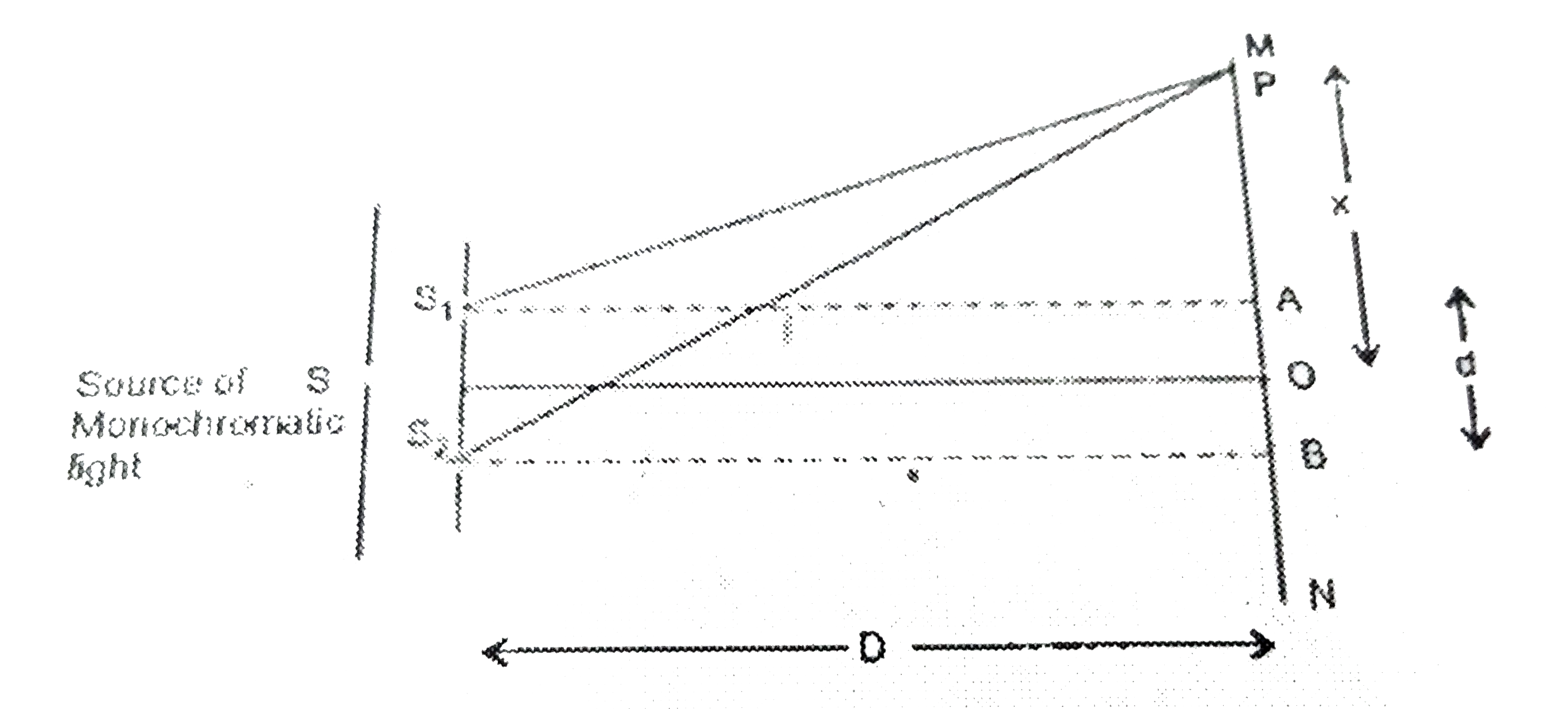 Light waves spread out from S and fall on both `S_1 and S_2`. The spherical waves emanating from `S_1 and S_2` will produce interference frings on the screen MN. In right `Delta S_1 AP`, we have, `(S_1P)^2=(S_1A)^2+(AP)^2` `S_1P=sqrt(D^2+(x-d/2)^2)=sqrt(D^2[1+((x-d/2)^2)/D^2])` `S_1P=D[1+((x-d/2)^2)/D^2]=D+((x-d/2)^2)/(2D)` Similarly `S_2P=D+((x+d/2)^2)/(2D)` Hence, path difference `= S_2P-S_1P` `=D+((x+d/2)^2)/(2D)-D-((x-d/2)^2)/(2D)=1/(2D)[x^2+d^2/4+xd-x^2-d^2/4+xd]` `=1/(2D).2xd=(xd)/D`. Now the intesity at point P is MAXIMUM or minimum according as the path difference is an integral multiple of wavelength or an odd intefral multiple of half wavelength. (i)For Brigth fringe (constructive interference) : We will have constructive interference resulting in abright fringe when path difference `=nlambda` `(xd)/D=nlambdarArrx=(nlambdaD)/d` `:._n=(nlambdaD)/d` where,`n=0pm1pm2...` Since, the separation between the centres of two consecutive bright fringes is called fringe width. It is denoted by `beta` `:. " Fringe width," beta=x_(n+1)-x_n`. `beta=((m+1)lambdaD)/d(nlambdaD)/d=(lambdaD)/d(n+1-n)` `:.beta=(lambdaD)/d` (ii)For Dark fringe (destructive interference): We will have destructive interference resulting in a dark fringe when path difference `=(2n+1)lambda/2` `(xd)/D =(2n+1)lambda/2rArr x=((2n+1)lambdaD)/(2d)` `:.x_n=((2n+1)lambdaD)/(2d)`, where,`n=0,pm1,pm2,...` Fringe width`beta=x_(n+1)-x_n` `=([2(n+1)+1]lambdaD)/(2d)-((2n+1)lambdaD)/(2d)=(2n+2+1-2n-1)(lambdaD)/(2d)=(2lambdaD)/(2d)` `:.beta=(lambdaD)/d` Hence, all bright and dark fringes are of equal width. Observations : (i)Fringe width is directly proportional to the wavalength of light i.e. `betaalphalambda`. (ii)Fringe width is inversely proportional to the distance between screen and two sourves i.e. `betaalpha1/d`. (iii)Fringe width is directly proportional to the distance between screen and two sources i.e. `betaalphaD` |
|