

Saved Bookmarks
| 1. |
Describethe Davisson and Germerexperiment. What did this experimentconclusively prove ? |
|
Answer» Solution :Davisson and Germer experiment : (1) The experiment arrangement is schematically shown in fig. (2) ELECTRONS from a filament F are rendered into a fine beam by applying a positive potential to the cylinder A. (3) A fine narrow beam of electronsis incident on the nickel crystal. The ELCTRONS are scattered in all directions by the atoms of the crystal ., (4) The intensityof the electron beam scattered in a given direction , is measured by the electron detector (collector) . The detector can be moved on a circularscale and is connectedto a sensitive galvanometer , whichrecords the current . (5) The deflection of the galvanometer is PROPORTIONAL to the intensity of the electron beam entering collector. (6)The apparatus is enclosed in an evacuated chamber . (7) The experiment was performed by varying the accelerating voltage from 44 V to 68 V . It is found that the intensity is maximum at `50^(@)` for a critical energy of 54 V.  (8)For `theta = 50^(@)` , the GLANCING angle , `phi` ( angle between the scatteredbeam of electron withthe plane of atoms of the crystal ) for electron beam will be given by ` phi + theta + phi = 180^(@)` ` phi = 1/2 [ 180^(@)-50^(@)]= 65^(@)` (9)According to Bragg's law for first order diffraction maxima (n =1) , we have 2 d `sin phi = 1 xx lambda rArr lambda= 2 xx 0.91 xx sin 65^(@) = 1.65 Å= 0.165`nm(experimentally ). ` [ :' `for Nickel crystal interatomic separation d = 0.91`Å` ] Accordingto de - Broglie hypothesis , the wavelengthof the waveassociated with electron is given by ` lambda =(12.27Å)/(sqrt(V)) = (12.27)/(sqrt(54))=1.67 Å= 0.167`(Theoritically) (11) The experimentally measured wavelength was found to be in confirmity with proving the existence of de - Brogliewaves. 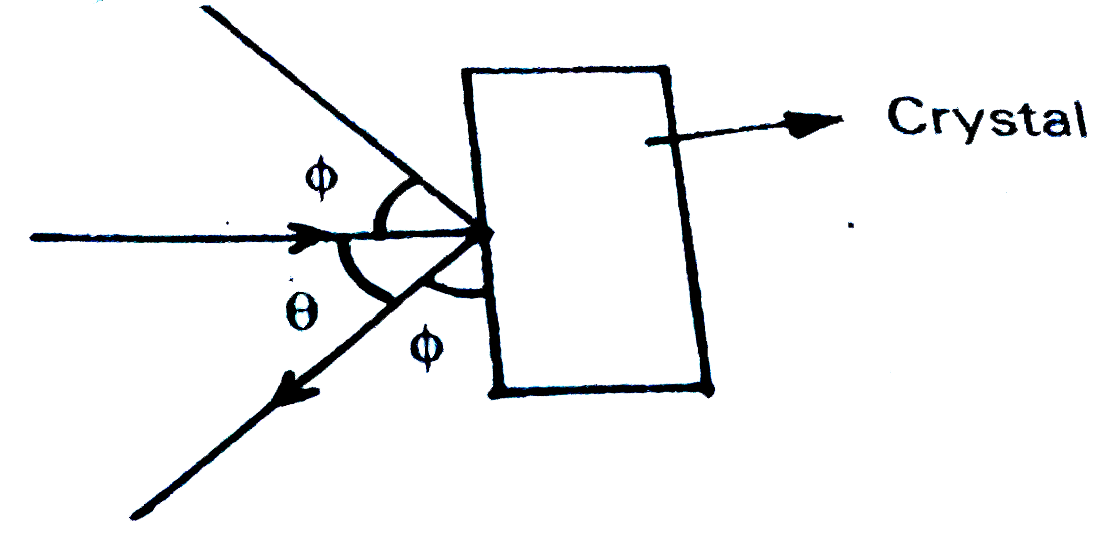
|
|