

Saved Bookmarks
| 1. |
Determine electric field intensity near an infinitely long straight uniformly charge wire. Or. Using Gauss' law expression for electric field intensity at a point situated at a distance 'r' from an infinitely long, uniformly charged straight wire. |
|
Answer» Solution :Gauss law states that total eneric FLUX over the closed surface S in vacuum is `(1)/(epsi_(0))` times the total charge contained inside surface S. `phi_(E)=ointvec(E).vec(dS)=(q)/(epsi_(0))` ELECTRIC field intensity due to a line charge. COnsider a thin charged rod with uniform linear charge density `lamda`. we wish to find an expression for electric intensity at point P at a perpendicular distance r, from the rod. consider a right circular cylinder of radius r and length l with the infinite long line of charge as its axis. In surface I and III, `VECE and vec(dS)` are `bot` to each other. in case of surface II, `vecE and vec(dS)` are parallel to each other and hence `theta=0^(@)` 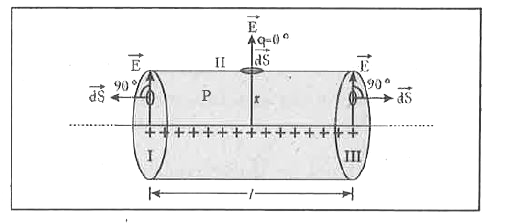 From Gauss.s theorem, we have `ointvec(E).vec(dS)=(q)/(epsi_(0))` or `oint_(I)vec(E).vec(dS)+oint_(II)vec(E).vec(dS)+oint_(III)vec(E).vec(dS)=(q)/(epsi_(0))` or `int_(I)EdScos90^(@)+int_(II)EdScos0^(@)+int_(III)EdScos90^(@)` `=(q)/(epsi_(0)0` or `0+Eint_(II)dS+0=(q)/(epsi_(0))` or `E(2pirl)=(q)/(epsi_(0))` or `E=(q)/(2pirlepsi_(0))` But `q=lamdal` `therefore E=(lamdal)/(2pirlepsi_(0))` or `E=(lamda)/(2pirepsi_(0))` |
|