

Saved Bookmarks
| 1. |
Deviation without dispersion and disperison without deviation What should be the condition on a combination of prism for the following ? (a) Angle of dispersion is zero but angle of deviation is not zero. |
|
Answer» Solution :(1) Deviation without DISPERSION is not possible for a single prism but we can combine two or more prisms so that dispersion is zero. Such a COMBINATION is known as achromatic combination of prisms. but in this case `theta_(1)+theta_(2)=0` Calculation We have `(n_(v_(1))-n_(R_(1)))A_(1)+(n_(V_(2))-n_(R_(2)))A_(2)=0` Since `n_(V)-n_(R )` is always greater than `0`, this is possible only where `A_(1)` and `A_(2)` are of the opposite signs. That is, `A_(2)=-((n_(V_(1))-n_(R_(1)))/(n_(V_(2))-n_(R_(2))))A_(1)` Now, `delta=delta_(1)+delta_(2)` `=(n_(V_(1))-1)A_(1)+(n_(v_(2))-1)A_(2)` `=(n_(V_(1))-1)A_(1)-(n_(V_(2))-1)((n_(V_(1))-n_(R_(1)))/(n_(V_(2))-n_(R _(2))))A_(1)` `=(n_(V_(1))-1)A_(1)[1-((n_(V_(1))-n_(R_(1)))/(n_(V_(1))-1)))((n_(V_(1))-1)/(n_(V_(2))-n_(R_(2))))]` `=delta_(1)[1-(omega_(1))/(omega_(2))]` (b) ANGLE of deviation is zero but angle of dispersion is not zero. (1) Dispersion without deviation is not possible for a single prism but we can combine two or more prisms so that deviation is zero. Such a combination is known as direct vision prism. (2) Mathematically we want that `delta_(1)+delta_(2)=0` but in this case `theta_(1)+theta_(2) ne 0` Calculation we know that `delta=delta_(1)+delta_(2)=0` where `delta` is average deviation for each prism , that is `(n_(V_(1))-1)A_(1)+(n_(V_(1))-1)A_(2)=0` `A_(2)=-(n_(Y_(1))-1)A_(1))/((n_(y_(1))-1))` This would mean that in this case also both angles of the prism are of opposite signs. `theta=theta_(1)+theta_(2)` Now, `theta_(1)=(n_(v_(1))-n_(R_(1))A_(1)` `theta_(2)=(n_(v_(2))-n_(R_(2))A_(2)` `theta=(n_(V_(1))-n_(R_(1)))A_(1)-(n_(V_(2))-n_(R_(2)))((n_(V_(1))-1)A_(1))/((n_(V_(2))-1))` Substituting the value of `A_(2)`, we get `(n_(V_(1))-n_(R_(1)))[1-[((n_(V_(2))-n_(R_(2)))/(n_(Y_(1))-1))((n_(Y_(2))-1)/(n_(V_(1))-n_(R_(2))))]]` Finally, we have `theta=theta_(1)+theta_(2)=theta_(1)[1-(omega_(2))/(omega_(1))]` (Only yellow color ray will not deviate, all other colored rays will deviate Learn : This kind of combination of prisms is possible only if the prisms are kept INVERTED with respect to each other as shown in the Fig. 34-67. 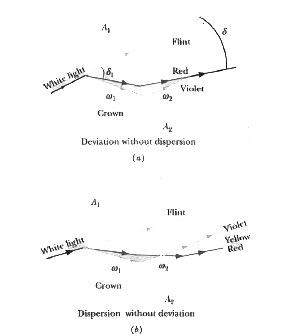 |
|