

Saved Bookmarks
| 1. |
Discuss Bohr's theory of the spectrum of hydrogen atom. |
|
Answer» Solution :1) According to Bohr's model an electron continuous to revolve round the nucleus in fixed, STATIONARY orbits. This is called ground state of the atom In ground state there is no EMISSION of radiation. 2) But when some energy is given to an atom the electron absorbs this energy. This is called excited state of the atom. In this state the electron jumps to the NEXT higher orbit. But it can remain `10^(-8)` sec and it immediatly RETURNS back to its ground state and the balance of the energy is emitted out as a spectral line. 3) According to Bohr's third postulate, the emitted energy is given by `E =hv = E_(2) - E_(1)` `"But "E_(2)=(-"me"^(4))/(8epsi_(0)^(2)h^(2))(1)/(n^(2))` and `E_(1)=(-"me"^(4))/(8epsi_(0)^(2)h^(2))(1)/(n_(1)^(2))" "(because Z=1)` `therefore barv =(1)/(lamda)=("me"^(4))/(8epsi_(0)^(2)ch^(3))[(1)/(n_(1)^(2)) (1)/(n_(2)^(2))]=R[(1)/(n_(1)^(2))-(1)/(n_(2)^(2))]" "[because v=(c)/(lamda)]` Where `R=(-"me"^(4))/(8epsi_(0)^(2)"ch"^(3))`= Rydberg const. 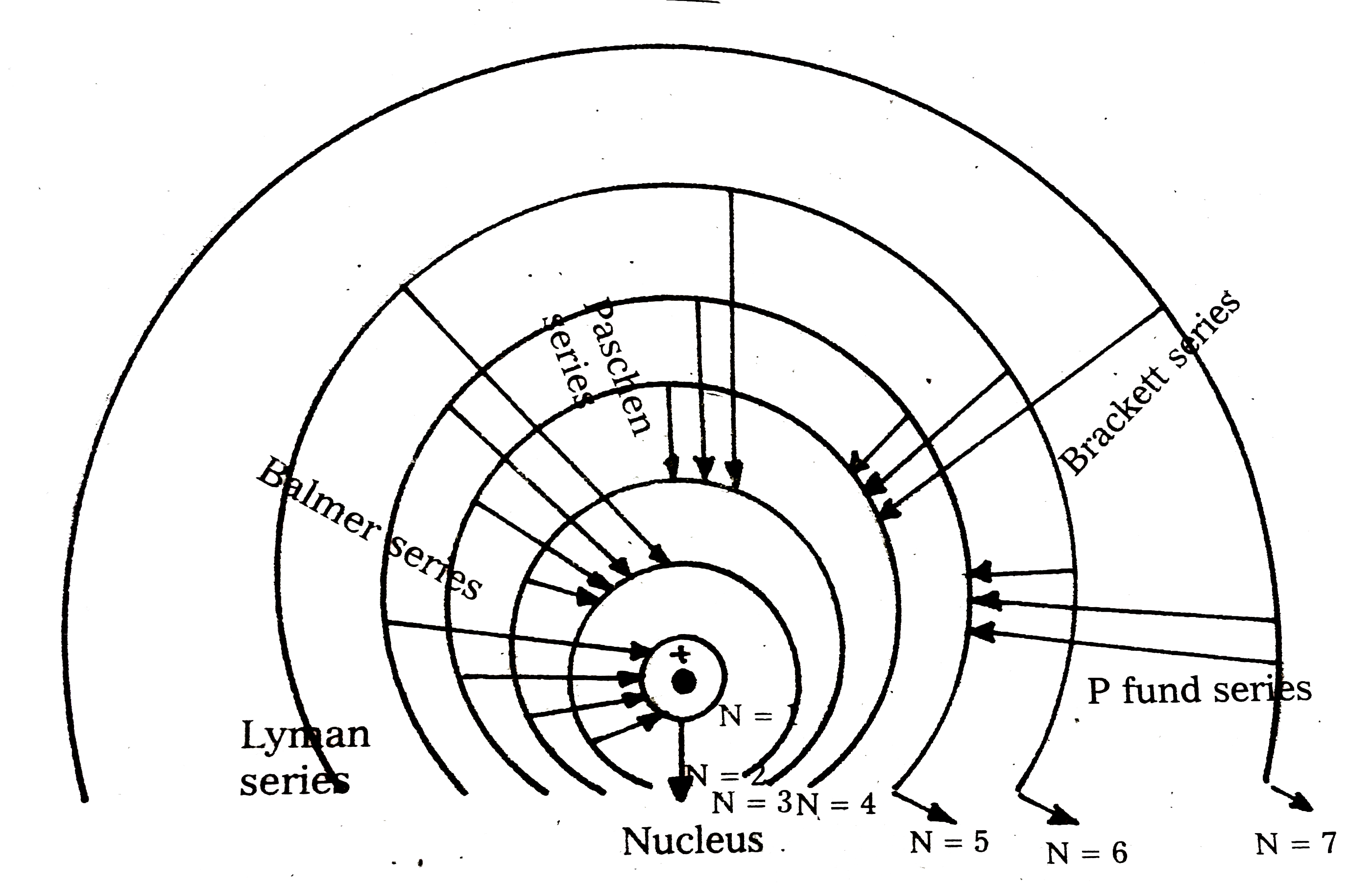 Hydrogen atom has five series of spectral lines. They are 1. Lyman series : When an electron jumps from the OUTER orbits to the first orbit, the spectral lines are in the ultra - violet region: Here `n_(1) = 1, n_(2) = 2, 3, 4, 5....` `(1)/(lamda)=R[(1)/(1^(2))-(1)/(n_(2)^(2))]=R[1-(1)/(n_(2)^(2))]` 2) Balmer Series : When an electron jumps from the outer orbits to the second orbit, the spectral lines are in the visible region. Here `n_(1) = 2, n_(2) = 3, 4, 5.....` `(1)/(lamda)=R[(1)/(2^(2))-(1)/(n_(2)^(2))]` 3) Paschen series : When an electron jumps from the outer orbits to the third orbit, the spectral lines are in the near infrared region. Here `n_(1)= 3, n_(2) = 4, 5, 6....` 4) Brackett series : When an electron jumps from outer orbits to the forth orbit, the spectral lines are in the infrared region. Here `n_(1) = 4, n_(2) = 5, 6, 7....` `(1)/(lamda)=R[(1)/(4^(2))-(1)/(n_(2)^(2))]` 5) Pfund series : When an electron jumps from outer orbits to the fifth orbit, the spectral lines are in the far infrared region. Here `n_(1). = 5, n_(2) = 6, 7, 8, .....` `(1)/(lamda)=R[(1)/(5^(2))-(1)/(n_(2)^(2))]` |
|