

Saved Bookmarks
| 1. |
Discussthe lowry-Bronsted concept of acids and bases. |
|
Answer» Solution :According to lowry-bronsted concept, an acid is defined as a substance that has a tendency to donate a proton to another substance the base is a substance that has a tendency to ACCEPT a proton from other substance. When hydrogen chloride is dissolved in water, it donates a proton to the LATER. Thus, HCl behaves as an acid and `H_2O` is base. the proton transfer from the acid to base can be represented as `HCl+H_2O leftrightarrow H_3O^(+)+CL^-` When ammonia is dissolved in water, it acceptsa proton from water. In this case,ammonia `(NH_3)` acts as a base and `H_2O` is acid. The reaction is represented as `H_2O+NH_3 leftrightarrow NH_4^(+)+ OH^-` Let us consider the reverse reaction in the following equilibrium. `HCl+H_2O leftrightarrow H_3O^+ +Cl^-` `H_3O^+` donates a proton to `Cl^-` to form HCl i.e., the products also behave as acid and base. In general, Lowry-Bronsted (acid-base) reaction in represented as `Acid_1+Base_2 leftrightarrow Acid_2+ Base_1` The species that remains after the DONATION of a proton is a base `(Base_1)` and is called the CONJUGATE base of the bronsted acid `(Acid_1)`. In other words , chemical species that differ only by a proton are called conjugate acid-base pairs. 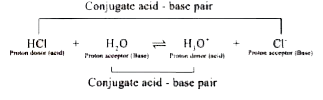 `HCl and Cl^-, H_2O and H_3O^+` are two conjugate acid-base pairs i.e., `Cl^-` is the conjugate base of the acid HCl (or) HCl is conjugate acidof `Cl^-`. SImilarity `H_3O^+` is the conjugate acid of `H_2O`. Limitations of lowry- Bronsted theory: Substance like `BF_3,AlCl_3` etc that do not donate protons are known to behave as ACIDS. |
|