

Saved Bookmarks
| 1. |
Draw a plot of BE/A versus mass number A for 2 le A le 170. Use this graph to explain the release of energy in the process of nuclear fusion of two light nuclei. OR Using the curve for the binding energy per nucleon as a function of mass number A, state clearly how the release in energy in the processes of nuclear fission and nuclear fusion can be explained. OR Draw a plot of the binding energy per nucleon as a function of mass number for a large number of nuclei, 2 lt A lt 240. How do you explain the constancy of binding energy per nucleon in the range 30 lt A lt 170 using the property that nuclear force is short-ranged ? |
Answer» Solution :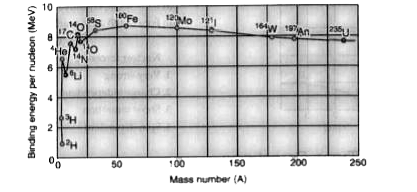 The above curve shows that (i) When a HEAVY nucleus breaks into two MEDIUM sized nuclei (in NUCLEAR fission) the BF/nucleon increases resulting in the release of energy. (ii) When two small nuclei combine to form a relatively bigger nucleus in nuclear fusion BF/nucleon increases, resulting in the release of energy. OR The constancy of the binding energy in the range `30 lt A lt 170` is a consequence of the fact that the nuclear force is short-ranged. If a nucleon can have a maximum of `p` neighbours WITHIN the range of nuclear force, itsbinding energy would be proportional top. If we increase A by adding nucleons they will not change the binding energy of a nucleon inside. Since most of the nucleons in a large nucleus reside inside it and not on the surface, the change in binding energy per nucleon would be small. Hence the binding energy per nucleon is a constant, (saturation property of nuclear forced.) |
|