

Saved Bookmarks
| 1. |
Draw a schematic diagram of a step-up transformer . Explain itsworking principle . Deduce the expression for the secondary to primary voltage in terms of the number of turns in the two coils . In an ideal transformer , how is this ratio related to the currents in the two coils ? How is the transformer used in large scale transmission and distribution of electrical energy over long distances ? |
|
Answer» Solution :Step-up transformer : Principle : It is a DEVICE which converts low voltage A.C. into high voltage A.C. It is based UPON the principle of mutual induction . When alternating current passed through a coil , an induced e.m.f. is set up in the neighbouring coil . Construction :A transformer consists of two coils of many turns of insulated copper wire wound on a closed laminated iron core . One of the coils known as primary (P) is connected to A.C. supply . The other coil known as secondary (S) is connected to the load. Working : When an alternating current is passed through the primary , the magnetic flux through the iron core changes which does two things.It produces e.m.f in the primary and an induced. e.m.f is also set up in the secondary . If the primary is negligible , the back e.m.f will be equal to the voltage applied to the primary. `therefore "" V_p = - N_p (d phi)/(dt ) and V_s = -N_s (d phi)/(dt)` where `N_p and N_5` are number turns in the primary and secondary respectively .`V_p and V_5`are their respective voltages. `therefore "" (V_s)/(V_p)=(N_s)/(N_p)` This ratio`(N_s)/(N_p)` is CALLED the turns ratio In a step- up transformer : `N_s gt N_p` So,`"" V_s gt V_p` Large scale transmission : The large scale transmission and distribution of electrical energy over long DISTANCES is done with the USE of transformer . The voltage output of the generator is stepped-up-so that current is reduced and power loss `I^(2) R` is cut down .It is then transmitted over long distances to an area sub- stations and utility poles before a power supply of 240 V reaches our homes . 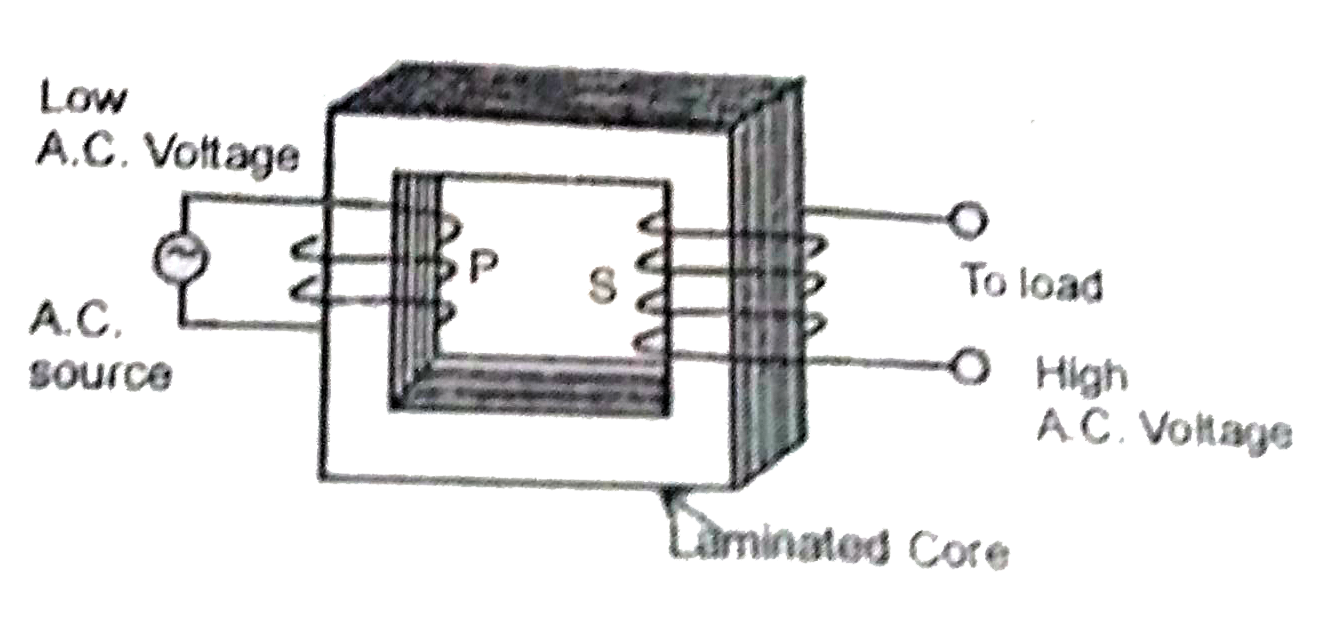
|
|