

Saved Bookmarks
| 1. |
Draw a simple circuit of a CE transistor amplifier. Explain its working. Show that the voltage gain, A_(v), of the amplifier is given by A_(v)= -(beta_(ac) R_(I))/(r_(i)), where beta_(ac) is the current gain, R_(L) is the load resistance and r_(i ) is the input resistance of the transistor. What is the significance of the negative sign in the expression of the voltage gain ? |
|
Answer» Solution :`V_(c c)=V_(cg)+I_(c )R_(z)` Likewise, the input loop gives `V_(B B)=V_(B B)+I_(B)R_(B)` Where `v_(i)` is not zero, we get `V_(B B)+V_(i)=V_(B B)+I_(B)R_(B)+Delta I_(B)(R_(B)+r)` The change in `V_(Bg)` can be related to the input resistance `r_(i)` and the change in `I_(g)`. Hence, `v_(i)=Delta I_(B)(R_(B)+r_(i))` `v_(i)=r Delta I_(B)` The change in `I_(B)` causes a change in `I_(C )` . We define a parameter `beta_(ax)`, which is similar to the `beta_(dc)` 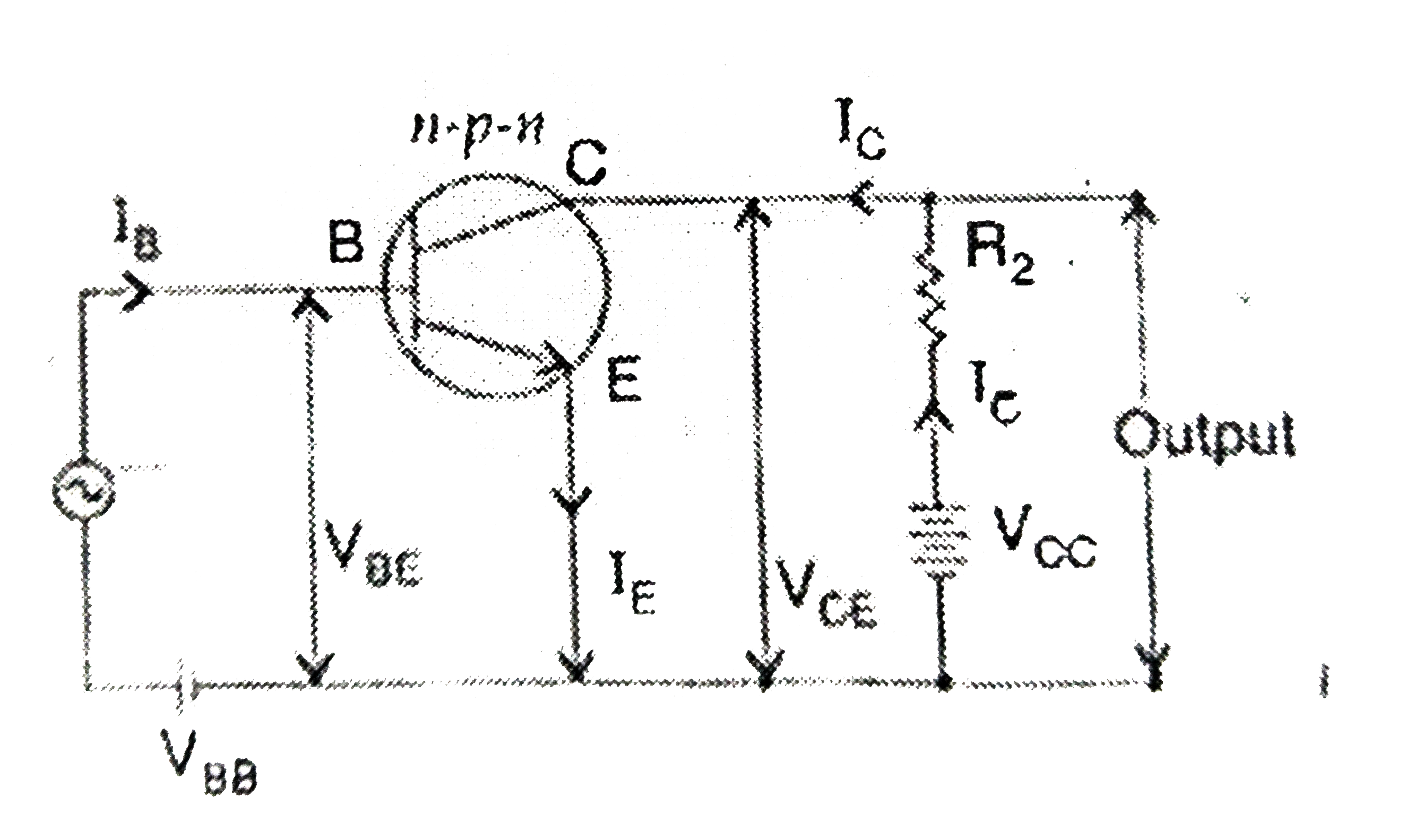 `beta_(ac)=(Delta I_(C ))/(Delta I_(B))=(i_(c ))/(i_(b))` which is also known as the ac current gain `A_(C )`. Usually `beta_(ac)` is dose to `beta_(dc)` in the linear region of the output characteristics. The change in `I_(c )` due to a change in `I_(B)` causes a change in `V_(CE)` and the voltage DROP across the resistor `R_(L)` because `V_(C C)` is FIXED. These CHANGES can be given by `Delta V_(C C)=Delta V_(CE)+R_(L) DeltaI_(C )=O` or `DeltaV_(CE)= -R_(L)Delta IC` The change in `V_(CB)` is the output voltage `v_(O)`. We get `v_(O)=Delta V_(CE)= - beta_(ac)R_(L)Delta I_(B)` The voltage gain of the AMPLIFIER is `A_(v)=(v_(o))/(v_(i))=(Delta V_(CB))/(r Delta I_(B)) implies A_(v)= - (beta_(ac)R_(L))/(r )` The negative sign indicates that output is phase reversed by an ANGLE `180^(@)`. |
|