

Saved Bookmarks
| 1. |
Draw the labelled ray diagram for the formation of image by a compound microscope. Derive the expression for the total magnification of a compound microscope. Explain why both the objective and the eyepiece of a compound microscope must have short focal lengths. |
Answer» Solution :(a) Image formation by a compound microscope : A schematic diagram of a compound microscope is shown in Fig. 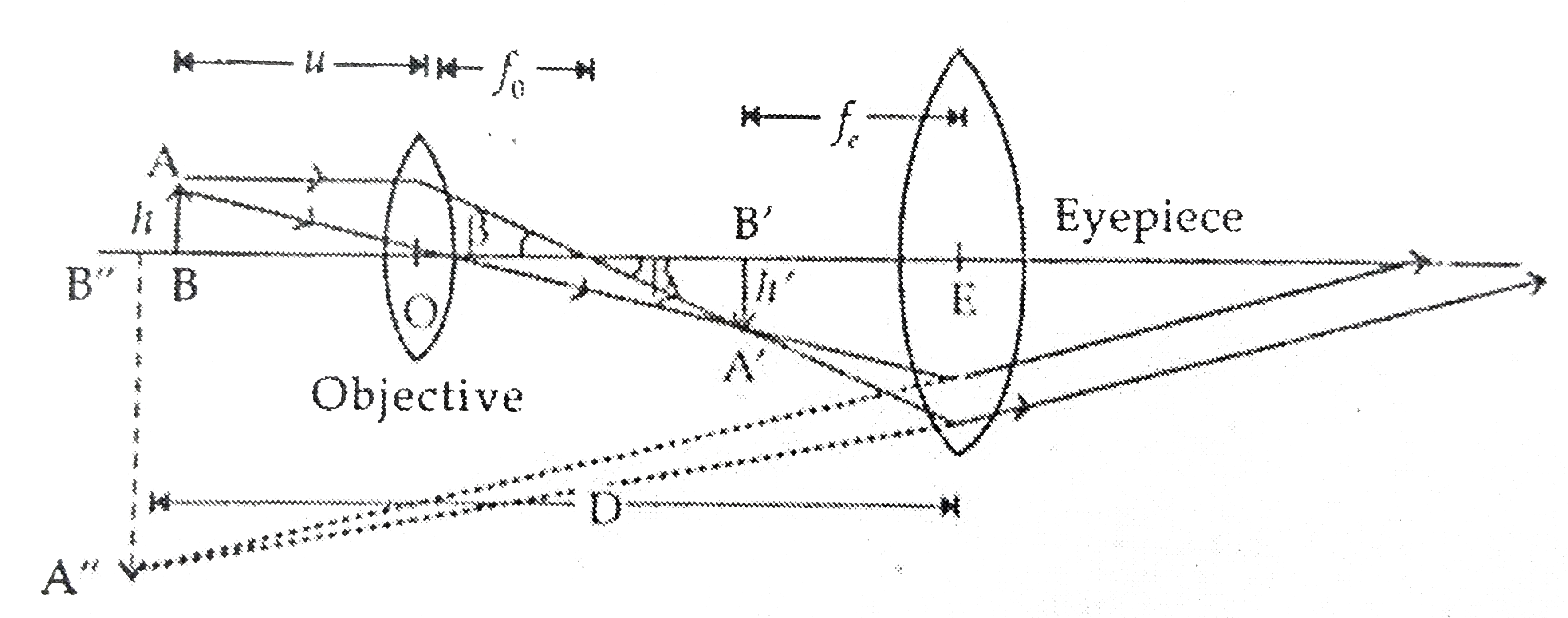 (b) Magnifying Power : The linear magnification `(m_(0))` due to the objective is `m_(0) = (A'B')/(AB) = (h')/(h)`..(i) Also `tan beta = (h)/(f_(0)) = (h')/(L)` `:. (h')/(h) = (L)/(f_(0))`...(ii) From (i) and (ii), we have `m_(0) = (L)/(f_(0))`..(iii) When h' is the size of the FIRST image, the object size being h and `f_(0)` being the focal LENGTH of the objective and L be the distance between the second focal POINT of the objective and first focal point of the eye PIECE (focal length `f_(E)`) is called the tube length of compound microscope. When the final image is formed at the near point, then the angular magnification `(m_(e))` of the eye piece is `m_(e) = (1 + (D)/(f_(e)))`...(iv) `:.` Total magnification of compound microscope is `m = m_(0).m_(e)` `m = ((L)/(f_(0))) (1 + (D)/(f_(e)))` [ From (iii) and (iv)] When the final image is formaed at infinity then, `m = ((L)/(f_(e))) ((D)/(f_(e)))` (c) For large magnifying power `f_(0) and f_(e)` both have to be small. Also `f_(0)` is taken to be smalller than `f_(e)` so that the field of view may be increased. |
|