

Saved Bookmarks
| 1. |
Drive expression for the total resistance of a circuit in which a few resistors are connected in parallel. |
Answer» Solution :Resistance in parallel. Resistances are said to be connected in parallel if one end of each resistance is connected at one point and other end is connected to another point so that the potential difference across each resistance is the same. However, CURRENT passing through each resistance is a part of the total current. 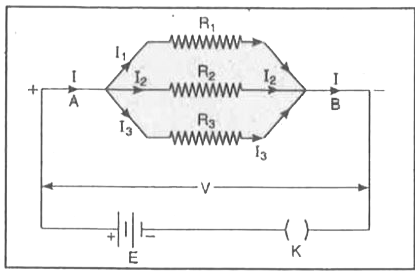 As shown in the figure. Let `R_(1),R_(2) and R_(3)` be three resistances connected in parallel and `I_(1),I_(2) and I_(3)` be currents flowing through `R_(1),R_(2) and R_(3)` respectively. I=total current flowing between A and B. V=potential difference difference across A and B. It is clear that `I=I_(1)+I_(2)+I_(3)`. . . (1) Since the potential difference across `R_(1),R_(2) and R_(3)` is the same i.e., `V,` according to Ohm.s law. `V=I_(1)R_(1),V=I_(2)R_(2) and V=I_(3)R_(3)` `THEREFORE I_(1)=(V)/(R_(1)),I_(2)=(V)/(R_(2)) and I_(3)=(V)/(R_(3))`. . . (2) If `R_(p)` is equivalent resistance of the parallel combination, then, `therefore I=(V)/(R_(p))`. . (3) Putting (2) and (3) in (1) we get `(V)/(R_(p))=(V)/(R_(1))+(V)/(R_(2))+(V)/(R_(3))` or `(1)/(R_(p))=(1)/(R_(1))+(1)/(R_(2))+(1)/(R_(3))`. . . (4) THUS we find that when a number of resistances are connected in parallel, the RECIPROCALS of the resultant resistance is EQUAL to sum of the reciprocal of individual resistances. It there are n resistances each equal to .R. and if these are in parallel, then resultant is given by : `(1)/(R_(p))=(1)/(R)+(1)/(R)+(1)/(R)+ . . .n` times `(1)/(R_(p))=(n)/(R) or R_(P)=(R)/(n)` Thus effective resitances decreases. |
|