

Saved Bookmarks
| 1. |
Explain abnormal molar masses. Also explain association and dissociation of solute. |
|
Answer» Solution :Dissociation : when ionic COMPOUNDS when dissolved in water dissociate into cations and anions, and increases number of soluble particles in solution which is known as dissociation. For example, if we dissolve one mole of KCl in water, we expect one mole each of `K^(+)` and `Cl^(-)` ions to be released in the solution. If we ignore interionic attractions, one mole of KCl in one kg of water would be expected to increase the boiling point by `2xx0.52 K = 1.04 K`. Now if we did not know about the degree of dissociation, we could be led to conclude that mass of one mole of KCl would be 37.25 g. This brings into light the rule that, when there is dissociation of solute into ions, the EXPERIMENTALLY determined molar mass is always lower than the true value. 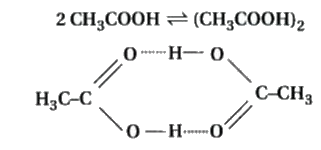 Molecules of acetic acid dimerise in benzene due to hydrogen bonding. This NORMALLY happens in solvents of low dielectric constant. In this case the number of particles is reduced due to dimerisation. Association of molecules is depicted as follows : It can be undoubtedly stated here that if all the molecules of ethanoic acid associate in benzene, then `Delta T_(B)` or `Delta T_(f)` for ethanoic acid will be half of the normal value. The molar mass calculated on the basis of this `Delta T_(b)` or `Delta T_(f)` will, therefore, be twice the expected value. Such a molar mass that is WITHER lower or higher than the expected or normal value is called as abnormal molar mass. |
|