

Saved Bookmarks
| 1. |
Explain (i) Cyclic silicates, (ii) Ino silicates. |
|
Answer» Solution :(i) Cyclic silicates: Silicates which contain `(SiO_(3))_(n)^(2n-)` ions which are formed by linking three or more tetrahedral `SiO_(4)^(4-)` units cyclically are called cyclic sicitates. Each silicate unit shares tow of its oxygen atoms with other units. EXAMPLE Beryl `[Be_(3)Al_(2)(SiO_(3))_(6)]` (an aluminosilicate with each aluminium is surrounded by 6 oxygen atoms octahedraly). 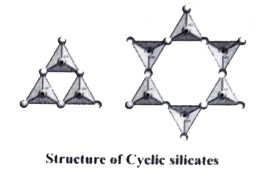 (ii) Ino silicones: Siliciates which contain n number of silicate units liked by sharing two or more oxygen atoms are called inosilicates. They are further classified as chain silicates and double chain silicates. 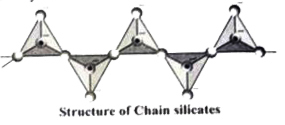 Chain silicates (or pyroxenes): These silicates contain `[(SiO_(3))_(n)]^(2n^(-)` ions formed by linkin n number of tetrahderal `[SiO_(4)]^(4-)` units lineary. Each silicate unit shares two of its oxygen atoms with other units. Example: Spondumene-`LiA[SIO_(3))_(2)`. Dougle chain silicates (or amphiboles): These silicates contains `[Si_(4)O_(11)]_(n)^(6n-)` ions. In these silicates there are two different typea of TETRAHEDRA, (i) Those sharing 3 vertices (ii) those sharing only 2 vertices. Examples, Absestos: These are are fibrous and noncombustible silicates. Therefore they are used for thermal insulation material, brake linings, construction material and filters. Asbestos being carcinogenic silicates, their APPLICATIONS are restricted. 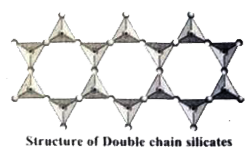
|
|