

Saved Bookmarks
| 1. |
Explain in detail how charges are distributed in a conductor and the principle behind the lightning conductor. |
Answer» SOLUTION :Distribution of charge in a conductor : Consider two conducting spheres A and B of radii `r_(1)` and `r_(2)` respectively connected to each other by a thin conducting wire as shown in the figure . The distacne between the spheres is much greater than the radii of either spheres. 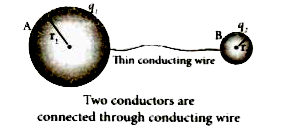 If a charge Q is introduced into any one of the spheres this charge Q is redistributed into both the spheres such that the electrostatic potential is same in both the spheres . They are now uniformly charged and attain electrostatic equilibrium . Let `q_(1)` be the charge residing on the surface of sphere A and `q_(2)` is the charge residing on the surgace of sphere B such that `Q= q_(1) + q_(2)` . The charges are distributed only on the surface and there is no net charge inside the conductor . The electrostatic potential at the surface and there is no net charge inside the conductor . The electrostatic potential at the surface of the sphere A is given by `V_(A) =(1)/(4epsilon_(0))(q_(2))/(r_(2))` The electrostatic potential at the surface of the sphere B is given by `V_(B) = (1)/(4piepsilon_(0))(q_(2))/(r_(2))` The surface of the conductor is an equipotential. since the spheres are connected by the conducting wire the surface of both the spheres together form an equipotential surface . This IMPLIES that `V_(A)= V_(B) "or " (q_(1))/(r_(1))=(q_(2))/(r_(2))` Let us take the charge density on the surface of sphere A is `sigma_(1)` and charge density on the surface of sphere B is `sigma_(2)` . This impliesthat `q_(1)= 4pir_(1)^(2)sigma_(1)` and `q_(2)= 4pir_(2)^(2)sigma_(2)`. Substituting these values into equation (3) we get `sigma_(1)r_(1)= sigma_(2)r_(2)` from which we conclude that `sigmar` = constant THUS the surface charge `sigma` is inversely proportional to the radius of the sphere . For a SMALLER radius the charge densitywill be larger and vice versa. Lightning arrester or lightning conductor : This is a device used top protect tall buildings from lightning strikes . It works on the principle of action at points or corona discharge. The device consists of a long thick copper rod passing from top of the building to the ground . The upper end of the rod has a sharp spike or a sharp needle. The lower end of the rod is onnected to the copper plate which is buried deep into the ground . When a negatively charged cloud is passing above the building it induces a positive charge on the spike. Since the induced charge density on thin sharp spke is large it results in a corona discharge. This positive charge ionizes the surrounding air which in turn neutralizes the negative charge in the cloud. The negative charge pushed to the spikes passes through the copper rod and is safely diverted to the Earth . The lightning arrester does not stop the lightning rather it divers the lightning to the groung safety. |
|