

Saved Bookmarks
| 1. |
Explain in detail the effect of a dielectric placed in a parallel plate capacitor. |
|
Answer» Solution :(i) When the capacitor is disconnected from the battery: Consider a capacitor with two parallel plates each of cross - SECTIONAL area A and are separated by a distance d. The capacitor is charged by a battery of voltage `V_(0)` and the charge stored is `Q_(0)` . The capacitance of the capacitor without the dielectric is `C_(0)= (Q_(0))/(V_(0))` The battery is then disconnected from the capacitor and thedielectric is inserted between the plates . The introduction of dielectric between the plates will decrease the electric field . Experimentally it isfound that the modifed electric field is given by `E = (E_(0))/(epsilon_(0))` 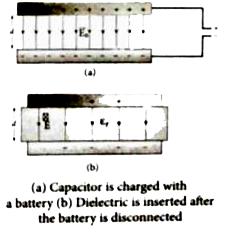 Here `E_(0)`is the electric field inside the CAPACITORS when there is no dielectric and `epsilon_(r)` is the relative permeability of the dielectric or simply known as the dielectric constant . Since `epsilon_(r) gt 1` the electric field `E lt E_(0)` . As a result the electrostatic potential difference between the plates ( V - Ed) is also reduced . But at the same time the charge `Q_(0)` will remain constant one the battery is disconnected. Hence the new potential difference is `V =Ed = (E_(0))/(epsilon_(0)) d = (V_(0))/(epsilon_(r))` We know that capacitance is inversely proportional to the potential difference . Therefore as V decreases C increases . Thus new capacitance in the presence of a dielectric is `C = (Q_(0))/(V) = epsilon_(0) (Q_(0))/(V_(0)) = epsilon_(r) C_(0)` Since `e_(r) gt 1` we have `C gt C_(0)` . Thus insertion of the dielectric `epsilon_(r)` increases the capacitance . Using equation . `C= (epsilon_(0)A)/(d) ` `C= (epsilon_(r)epsilon_(0)A)/(d) = (epsilonA)/(d)` where `epsilon= epsilon_(r)epsilon_(0)` is the permittivity of the dielectric medium . The energy stored in the capacitor before the insertion of a dielectric is given by `U_(0)=(1)/(2) (Q_(0)^(2))/(C_(0))` After the dielectric is inserted the charge `Q_(0)` REMAINS constant but the capacitance is increased . As a result the stored energy is decreased . `U = (1)/(2) (Q_(0)^(2))/(2C) =(1)/(2) (Q_(0)^(2))/(2epsilon_(r)C_(0))= (U_(0))/(epsilon_(r))` Since `epsilon_(r) gt 1 ` we GET `U lt U_(0)` . There is a decrease in energy because when the dielectric is inserted the capacitor spends some energy in pulling the dielectric inside . (ii) When the battery remains connceted to the capacitor : Let us now condsider what happens when the battery of voltage `V_(0)` remains connceted to the capacitor when the dielectric is inserted into the capacitor . The potential difference `V_(0)` across the plates remains constant . But it is found experimentally ( first shown by Faraday ) that when dielectric is inserted the charge stored in the capacitor is increased by a fatcor `epsilon_(r)` . `Q= epsilon_(r) Q_(0)` Due to this increased charge the capacitance is also increased . The new capacitance is `C= (Q)/(V_(0))= epsilon_(r) (Q_(0))/(V_(0))= epsilon_(r)C_(0)` 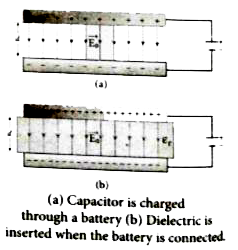 However the reason for the increase in capacitance in this case when the battery remains connected is diferent from the case when the battery is disconnected before introducing the dielectric . Now `C_(0)= (epsilon_(0)A)/(d) ` and `C= (epsilon_(0)A)/(d)` The energy stored in the capacitor before the insertion of a dielectric is given by `U_(0)=(1)/(2)C_(0)V_(0)^(2)` Note that here we have not used the expression `U_(0)=(1)/(2)(Q_(0)^(2))/(C_(0))` because here both charge and capacitance are changed whereas in equation 4 `V_(0)` remains constant . After the dielectric is inserted the capacitance is increased hence the stored energy is also increased . `U =(1)/(2) CV_(0)^(2) = (1)/(2)epsilon_(r)CV_(0)^(2)= epsilon_(r)U_(0)` Since `e_(r) gt 1` we have `U gt U_(0)` It may be noted here that since voltage between the capacitor `V_(0)` is constant the electric field between the plates also remains constant . |
|