

Saved Bookmarks
| 1. |
Explain optical isomerism in coordination comounds with an example. |
|
Answer» Solution :`(i)` COORDINATION compounds which possess chairality exhibit optical isomerism similar to organic compounds. `(ii)` The pair of two optically acitve isomers which are mirror images of each other are called enantiomers. `(iii)` Their solutions rotate the plane of the plane polarised light either clockwise or anticlockwise and the corresponding isomers are called `d` (dextrorotatry) and `I` (levelortatory) forms respectively. `(iv)` The octahedral complexes of type `[M(x x)3]^(n+-)`, `[Mx x)_(2)AB]^(n+-)` and `[M(x x)_(2)B_(2)]^(n+-)` exhibit optical isomerism. Examples : `(i)` The optical isomers of `[Co(en)_(3)]^(3+)` are shown below. 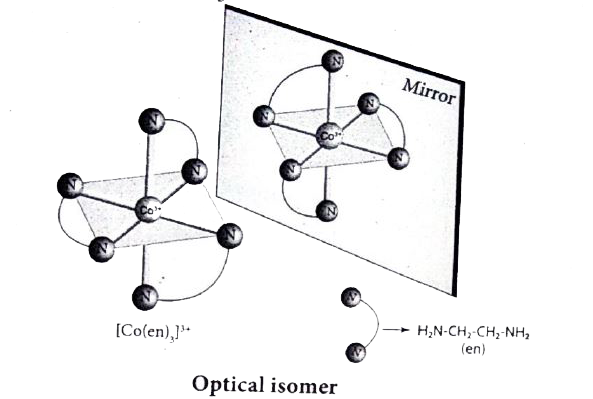 `(ii)` The coordination complex `[CoCl_(2)(en)_(2)]^(+)` has three isomers, two optically active cis forms and one optically INACTIVE trans form. These STURCTURES are shown below. 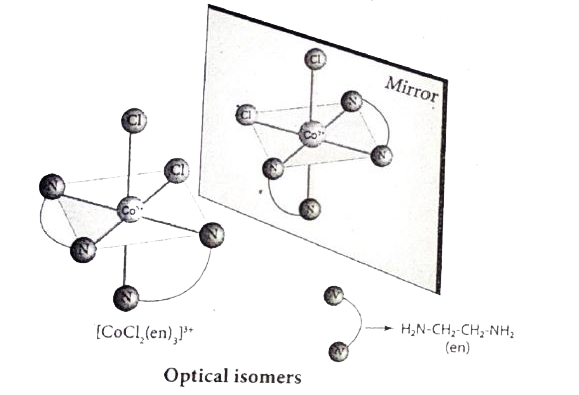 `(iii)` In a coordination compound of type `[PtCl_(2)(en)_(2)]^(2+)`, two geometrical isomers are possible . They are cis and trans. Among these two isomers cis isomer shows optically active isomerism because the whole molecule is asymmetric. 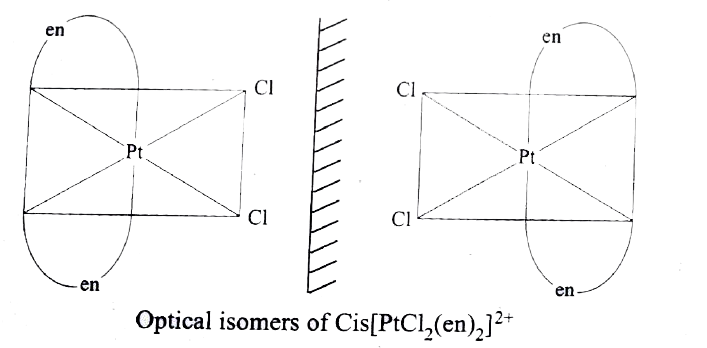
|
|