

Saved Bookmarks
| 1. |
Explain reactivity of halogens with oxygen. OR Write a note on oxides of halogens. |
|
Answer» Solution :Halogens form many oxides with oxygen but most of them are unstable. Fluorine does not forms oxides. The compounds of oxygen with fluorine are called fluorides because fluorine is more electronegative than oxygen. Fluorides of oxygen are `OF_2` and `O_2F_2`. Both are strong fluorinating agents. `O_2F_2` oxidises Pu to `PuF_6` and the reaction is used in removing plutonium as `PuF_6` from spent nuclear fuel. Chlorine oxides, `Cl2_O, ClO_2, Cl_2O_6` and `Cl_2O_7` are highly REACTIVE oxidising agents. They tend to explode.`ClO_2` is used as a bleaching agent for PAPER pulp and textiles and in water treatment. The STABILITY of oxides of chlorine can be explained due to fact that multiple bond formation between oxygen and chlorine takes place due to availability of d-orbitals in chlorine. The bromine oxides, `Br_2O, BrO_(2), BrO_3` are the least stable halogen oxides (middle row anomanously) and exist only at LOW temperatures. They are very powerful oxidising agents. The bromine oxides are least stable because : (i) Bromine cannot form multiple bonds with oxygen. (ii) Very less polarizability of Br-0 bond. The iodine oxides, `I_(2)O_(4), I_(2)O_(5), I_(2)O_(7)` are insoluble solids and decompose on heating. `I_2O_5` is a very good oxidising agent and is used in the estimation of carbon monoxide. The kinetic and thermodynamic studies show that stability of oxides of halogen follows the order : I > CI > Br. Iodine oxides are highly stable because of greater polarizability of bond between iodine and oxygen. The stability of oxides increases with the increase in NUMBER of oxygens in the compound. 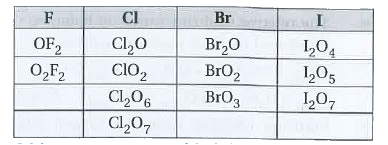
|
|